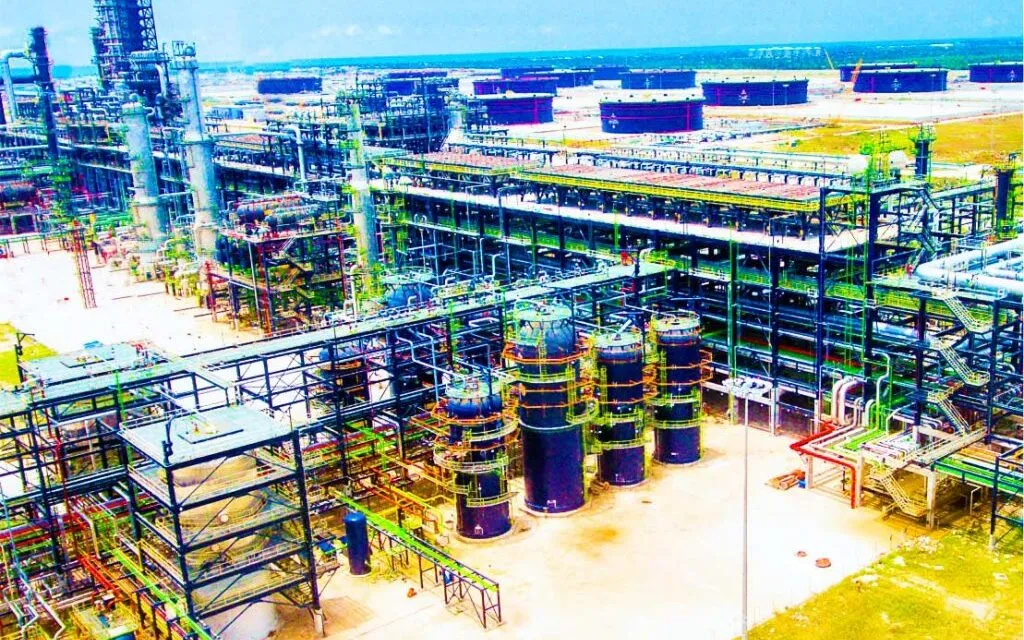
Nigeria’s expanding refining industry is facing a crucial test: whether increased domestic production can translate into more dependable fuel supplies for the economy as international petroleum-product shortages and price differences across African borders reshape the market.
The contradiction is striking. The Dangote Petroleum Refinery operated at 105.21 percent of capacity in August, while Nigeria’s dependence on imported petrol declined significantly. Yet consumers and businesses remain exposed to rising fuel costs, underscoring the limits of domestic refining as a shield against international energy-market shocks.
The pressure comes as the recovery in global crude-oil exports outpaces that of refined petroleum products. Middle East crude exports, excluding Iran, recovered to about 91 percent of their pre-war levels in September, according to Reuters, citing shipping-data provider Vortexa. Refined-fuel exports, however, remained at approximately 60 percent of their pre-war volume, leaving international product markets under strain.
For Nigeria, the challenge extends beyond replacing imported petrol with locally refined supplies. The country is emerging as a supplier to neighbouring African markets where petroleum products can command higher prices, creating commercial incentives for fuel to move across borders.
David Precious, senior market analyst at EBC Financial Group, said petrol sells for approximately 25 percent more in Togo than in Nigeria and more than 50 percent more in Ghana, based on the price comparisons cited in his firm’s analysis sent to Business a.m.
The disparity raises a question for policymakers and the downstream industry: how can Nigeria strengthen its position as a regional refining hub while ensuring that domestic demand is adequately supplied?
Domestic refining gains ground
Figures released by the Nigerian Midstream and Downstream Petroleum Regulatory Authority (NMDPRA) show that Nigeria’s petrol supply structure is changing.
The regulator’s August 2026 statistics put average daily petrol receipts at 50.5 million litres, up from 45.5 million litres in July. Domestic petrol receipts rose by 39 percent to 35.9 million litres daily, while imported volumes fell by 26 percent to 14.6 million litres.
The Dangote refinery produced an average of 41.94 million litres of petrol daily during the month and recorded capacity utilisation of 105.21 percent. The refinery also supplied diesel and aviation fuel to the domestic market and exported petroleum products.
However, NMDPRA data showed that petrol volumes trucked into the domestic market averaged 41.5 million litres daily in August, down from 48.1 million litres in July. Petrol stock sufficiency stood at 22.9 days at the end of August, compared with 22.4 days a month earlier.
The figures demonstrate the growing importance of domestic refining, but they do not, by themselves, establish that Nigeria was experiencing a nationwide physical shortage during the period. They also highlight why supply, consumption and inventory data must be assessed together.
The price challenge remains significant. International crude and refined-product prices influence the cost of supplying the domestic market, while the relationship between Nigerian pump prices and those in neighbouring countries can affect commercial decisions about where products are sold.
Regional demand complicates the picture
Nigeria’s expanding refining capacity has enabled the Dangote refinery to supply markets beyond its domestic base, including Ghana, Togo, Cameroon, Côte d’Ivoire and Tanzania.
That regional reach creates opportunities for export revenue and strengthens Nigeria’s role in African energy trade. But when supplies are constrained and neighbouring markets offer higher prices, the commercial incentives influencing where products are sold become increasingly important.
Aliko Dangote, president of the Dangote Group, warned in September that petrol prices in some neighbouring countries were 30 to 50 percent higher than in Nigeria. He also said fuel intended for the Nigerian market was being diverted across borders.
His comments highlight a potential vulnerability in the domestic supply chain. A price differential can create an incentive for diversion, but the extent of its impact on Nigerian consumers must be established through evidence of actual cross-border flows, domestic deliveries and consumption.
Crude availability also remains part of the equation. The refinery has previously said it requires 13 to 15 crude cargoes monthly, while its allocation from the Nigerian National Petroleum Company Limited has varied. The refinery supplements its allocation by purchasing crude at international prices.
The challenge for policymakers is therefore to ensure that refining capacity, access to feedstock, domestic deliveries and market incentives work together to support reliable local supply.
Paul Dozie Arinze, an energy industry expert and President of Pedestal Africa Limited, told Business a.m. that Nigeria need not worry too much about refined products or producers moving to neighbouring markets which offer higher margins.
“For one thing, it’s inevitable, and trying to stop it only creates distortion and distraction. In fact those secondary markets can become feeders for a larger, more viable regional market, making investment more attractive at scale, especially in the light of the Africa continental trade agreement (AfCFTA),” Arinze said.
He advised that the smarter thing was to stay focused on keeping the market dynamic, maintaining a viable mix of supply options and incentivising growth.
Global product shortages remain a concern
The International Energy Agency has reported that global refinery activity remains affected by disruptions to international petroleum supply chains. Its September Oil Market Report noted that refined-product and liquefied petroleum gas exports from the Gulf remained nearly 60 percent below their February levels.
The disruption matters to African economies because many remain dependent on imported finished petroleum products. Afreximbank estimated in 2025 that the continent spends approximately $30 billion annually on refined-fuel imports.
Nigeria’s expanding refining capacity offers a potential buffer against these pressures, but the country is not entirely insulated from international crude prices, the cost of supplementary feedstock or competition for petroleum products.
The next NMDPRA supply figures will be important in determining whether domestic refining is keeping pace with demand and how much fuel is reaching Nigerian consumers.
For businesses and households, the central concern remains the price and reliability of fuel rather than refinery utilisation alone.
Nigeria’s refining expansion has reduced its dependence on imported petrol, but the current market demonstrates that local production cannot fully insulate consumers from global price movements. The next test is whether the country can convert its growing industrial capacity into dependable domestic supply while managing the demands of an increasingly interconnected regional market.