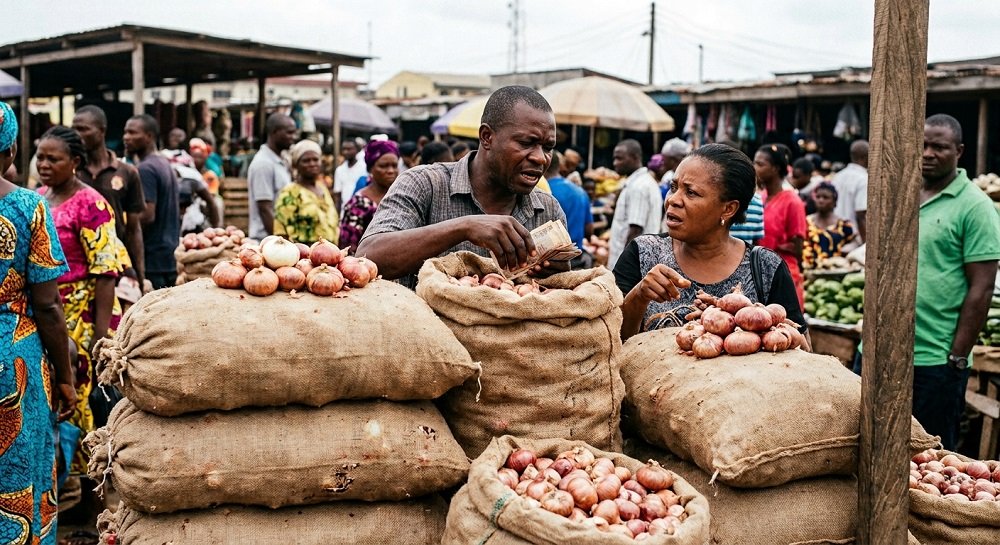
The cost of onions could enter uncharted territory in the coming months, with farmers forecasting prices of N300,000 per bag as poor wet-season harvests, weather-related losses and cross-border trade disruptions threaten supply.
The outlook comes as NOPMAN suspends exports to Ghana and calls for ECOWAS intervention, adding a regional trade dimension to an emerging domestic supply problem.
Mohammed Bello, an onion farmer based in Zaria, Kaduna State, told Business A.M. that the supply outlook for the next several months was already weak before the latest trade disruption.
“Onion will be very expensive at the end of the year because we are already experiencing a very poor wet-season onion harvest,” Bello said.
He projected that the price of a bag of onions could rise to N300,000 or more in November, December, January and early February if supply conditions do not improve.
The projection represents a potentially worrisome escalation from current market levels.
The price of a large bag of onions rose from N75,000 in June to N105,000 in July, a 40 percent month-on-month increase, according to traders.
If the upper end of Bello’s forecast materialises, the price would be almost thrice the July level, threatening to make onions a more expensive household staple while increasing costs for restaurants, food processors, caterers and other businesses.
Traders attributed the recent increase to seasonal shortages in major northern producing areas, while heavy rainfall in some locations has disrupted harvesting, storage and transportation.
The wet season presents particular challenges for a crop that requires careful harvesting, drying and storage. Poor weather conditions can reduce marketable output while increasing post-harvest losses and logistics costs.
The latest export suspension could further complicate the supply picture.
Aliyu Maitasamu, national president of the National Onion Producers and Marketers Association of Nigeria (NOPMAN), said exports to Ghana would remain suspended until Nigeria and Ghana reached an amicable and mutually acceptable agreement on the modalities governing onion trade.
He said the decision was not intended to undermine regional commerce but to draw attention to the difficulties Nigerian traders face and force a resolution of the dispute.
“Suspension will remain in force until an amicable and mutually acceptable agreement is reached between the two countries on the modalities governing onion trade,” Maitasamu said.
NOPMAN has sought ECOWAS intervention and urged both governments to address the dispute urgently.
The association warned that prolonged disruption could generate losses across the onion value chain, affecting farmers, producers, exporters, transporters, wholesalers, retailers and other businesses.
Ghana dispute adds uncertainty
The dispute is not the first interruption to Nigeria-Ghana onion trade this year.
Earlier in 2026, Nigerian traders reportedly halted supplies to Ghana following allegations of harassment and the seizure of onion-laden trucks belonging to Nigerian traders at the Kotoku Market in Accra.
NOPMAN had subsequently called for greater protection of Nigerian traders and urged the two countries and regional authorities to uphold ECOWAS protocols on the free movement of goods and fair trading practices.
The renewed suspension comes at a particularly sensitive point for Nigeria’s domestic market.
While halting exports to Ghana could theoretically leave more onions available for domestic consumers, traders and farmers say the disruption could have wider consequences for the value chain.
Export markets provide farmers and aggregators with additional outlets for produce, supporting volumes, price discovery and cash flow. A breakdown in cross-border trade can therefore disrupt established commercial relationships and leave producers exposed to logistics and market-access risks.
At the same time, if domestic production falls during the wet season, Nigeria could face a situation in which supply is inadequate despite the suspension of exports.
N1.17trn industry at risk
The stakes are significant given the size of Nigeria’s onion economy.
According to NOPPMAN, Nigeria produces about 2.1 million metric tonnes of onions annually, with an estimated value of N1.17 trillion. Nigeria is Africa’s second-largest onion producer after Egypt,the association stated further.
Nigerian onions are supplied across West and Central Africa and also reach some European markets, making the crop an important component of regional agricultural commerce.
NOPPMAN said onion production contributes significantly to rural livelihoods and the wider agricultural economy, while government interventions involving improved seeds, fertiliser and agrochemicals had helped stabilise production.
The association said it is also working with government agencies and industry partners to improve market access, reduce export costs and streamline logistics.
NOPPMAN further stated that it is partnering with the Nigerian Export Promotion Council to facilitate exports of processed onion products and has worked with partners in Ghana, Niger Republic and Burkina Faso to improve cross-border trade.
But the latest trade dispute highlights the vulnerability of those gains to non-tariff barriers and disruptions along regional trade corridors.
Weather becomes biggest risk
For consumers, however, the immediate concern is likely to be domestic availability and price.
The onion farmer in Zaria said the poor wet-season harvest could become the dominant factor determining prices in the coming months.
If harvesting remains weak and storage losses increase, traders may have to compete for smaller volumes of marketable onions, potentially pushing wholesale and retail prices higher.
The seasonal pressure could become more pronounced towards the end of the year and into early 2027, when the current harvest cycle tightens supply.
A rise towards N300,000-N500,000 per bag would have consequences beyond household food budgets.
Restaurants and food vendors would face higher input costs, while processors, caterers and retailers could either absorb the increase through narrower margins or pass it on to consumers.
Transporters and wholesalers could also see higher working-capital requirements as the cost of securing each consignment increases.
Food inflation risk
The potential onion price shock comes as Nigerian households and businesses remain sensitive to food and logistics costs.
Although onions represent only one component of the food basket, sharp increases in the price of widely consumed staples can influence consumer spending patterns and raise operating costs across food-related businesses.
For small restaurants and food vendors operating on thin margins, sustained increases could become particularly difficult to absorb.
The combination of weather-related supply constraints, storage losses, transportation costs and uncertainty around regional trade therefore creates a risk of a prolonged price spike rather than a temporary market adjustment.
Nigeria seeks bigger onion economy
Despite the immediate supply concerns, industry leaders see significant room for expansion.
The NOPPMAN president said the association’s agenda includes increasing production capacity, improving processing, expanding export opportunities and strengthening the welfare of farmers and marketers.
He also called for greater investment in onion processing to increase value addition and reduce losses.
The association stated that it has trained farmers in good agricultural practices and promoted access to quality inputs, while improved marketing and export promotion remain central to its 2026 strategy.
The scale of Nigeria’s onion industry (about 2.1 million tonnes of annual production and an estimated N1.17 trillion in value), masks a fragile supply chain.
Insufficient irrigation, inadequate storage, post-harvest losses, costly transportation and disruptions to regional trade continue to expose the market to seasonal swings. Without addressing these bottlenecks, higher production will not necessarily translate into lower or more stable prices.
All eyes are now on the wet-season harvest. If the expected shortfall materialises, onions could enter the dry season as one of the country’s most expensive food commodities, adding another layer of pressure to household consumption and business costs.