Nigeria’s economy is looking better now than it was six months ago although there is still a debate whether this is just on paper or in the pocket of the average Nigerian. Back in 2025, I took a close look at the numbers and saw that the reforms were working, even if it wasn’t obvious right away. But now, the results are clear – at least in the big picture, if not yet in people’s everyday lives.
In the first half of 2026, Nigeria’s economy grew faster than it has done in the last decade. This appears to be unprecedented despite not being evident — inflation dropped by almost half from the year before driven by the change in the base period from 2010 to 2024 to reflect updated economic realities, the value of the naira stopped falling and even started to rise, the country’s external reserves are at their highest point in seventeen years, and the stock market had a few crazy days in May where it created more wealth than ever before in Nigeria’s history.
Here’s the good news – there’s plenty of it. But let’s be honest, the reality on the ground is a different story. The average Nigerian household isn’t feeling the benefits, and that’s a huge problem. The gap between the big-picture data and the everyday experiences of people like the market woman is the most important thing to understand about this economy right now. It sets the tone for everything else. In this review, we’ll take a closer look at how the first six months of the year played out, sector by sector, and try to make an honest prediction about what the second half of the year might hold.
Reality VAR at half-time not influenced by FIFA rules
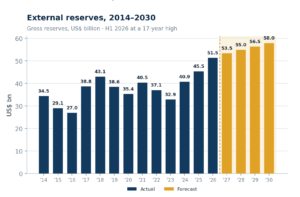
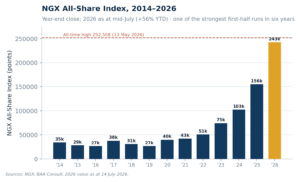
Let’s take a closer look at the numbers. The growth rate of real GDP was 3.89 percent in the first quarter of 2026, which is an increase from 3.13 percent in the same quarter of 2025. Meanwhile, headline inflation decreased to 15.91 percent in June, down from 25.29 percent in June 2025. The exchange rate between the naira and the dollar was around ₦1,383 on the official market in mid-July, while the parallel market rate was roughly ₦1,420, resulting in a premium of less than three percent (3%) – a difference that has essentially disappeared. As of the end of June, the country’s gross external reserves stood at approximately $51.45 billion, a level that has not been seen since January 2009. In the first quarter alone, capital importation reached $10.37 billion, representing an 83.83 percent increase from the same period last year. Furthermore, tax collections by the federation totalled ₦21.6 trillion in the first half of the year, marking a 49 percent rise. The Nigerian Exchange All-Share Index also performed well, closing the first half up by roughly 46 percent and briefly reaching an all-time high above 250,000 points in May.
It looks great on paper, almost like a dream come true for anyone in charge of finance. The changes that started in May 2023, like getting rid of fuel subsidies, letting the naira’s value float, and tightening up monetary policy, seem to be working based on these numbers. They’re giving us the results that the people who made these changes promised. But now that we’re halfway through, we should be asking if these numbers tell the whole story. Are they just a one-time lucky break, or is this progress really going to last?
| Indicator | H1 2026 | H1 2025 | Direction |
|---|---|---|---|
| Real GDP growth (Q1, y/y) | 3.89% | 3.13% (Q1’25) | ▲ faster |
| Headline inflation (June, y/y) | 15.91% | 25.29% (Jun’25) | ▼ lower |
| Food inflation (June, y/y) | 17.52% | 25.41% | ▼ lower |
| Monetary Policy Rate | 26.50% | 27.50% | ▼ easing |
| Exchange rate (official, ₦/$) | ₦1,383 | ~₦1,530 (mid’25) | ▲ firmer naira |
| Parallel-market premium | <3% | wide | ▼ narrower |
| External reserves | $51.45bn | ~$37.9bn | ▲ higher |
| Capital importation (Q1) | $10.37bn | $5.64bn | ▲ +83.8% |
| Federation tax (H1) | ₦21.6tn | ~₦14.5tn | ▲ +49% |
| NGX All-Share Index (H1 return) | +46% | — | ▲ record run |
Sources: NBS, CBN, NGX, APPNL Research
The Nigerian economic growth shares similarity with tuber crops
Nigeria’s economy had a pretty good start to the year, with a 3.89 percent growth in the first quarter – its strongest in about ten years. This is especially notable since we’re now looking at a more comprehensive picture of the economy, thanks to updated national accounts. The services sector was the main driver, making up 57.73 percent of the real output and growing by 4.31 percent, largely due to strong performances in information and communication technology and financial services. Agriculture also bounced back, growing 3.15 percent after being almost stagnant the previous year, and industry saw a 3.50 percent increase. What’s interesting is that the non-oil sector accounted for a large share of 96.08 percent of the country’s real GDP, while oil, despite all the attention it gets, only made up 3.92 percent.
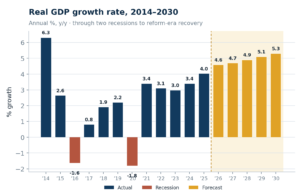
Sources: NBS, APPNL Research
If we take a step back and look at the bigger picture, we can see that the story of Nigeria’s economy is more complex than just a single quarter’s data. The historical numbers tell us that agriculture is still the biggest sector, making up about 23 percent of the country’s GDP. However, it’s not very productive, which is why we have more food available, but it’s still not affordable for many people. On the other hand, manufacturing has been growing slowly and now makes up around 10 percent of the economy, but it’s mostly foreign investors who are driving this growth – in fact, about 70 percent of the new members of the Manufacturers Association of Nigeria in the first quarter of 2026 were from outside the country. The services sector is the largest, but a lot of the activities in this sector don’t add much value or create many jobs. So, while the economy is growing, it’s not changing the underlying structure that has been holding it back for decades – it’s still not creating enough good jobs for the people who need them.
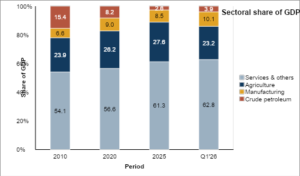
Sources: NBS, APPNL Research
The kind of growth that appears in the financial records but doesn’t reflect in the actual salary is what we call growth on probation. It’s a real thing, and we should definitely acknowledge it. However, it’s not the only thing that matters, especially to someone who’s reading this while enjoying a simple breakfast of ‘akara’ and pap or a simple lunch of agbado and agbon. The real question on their mind is: has life become more affordable for them to upgrade from eating Suya for dinner to Balangu? Honestly, the answer is that things are a little less difficult, but not quite better yet.
Wallet and savings still empty despite inflation flattening on paper
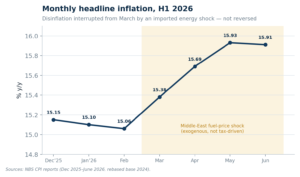
The reform camp has a lot to be proud of, and one of their biggest achievements is the decrease in inflation. In June, the overall inflation rate went down to 15.91 percent, which is two basis points lower than the 15.93 percent in May 2026. If we look back, it’s even more impressive – inflation has dropped by more than 10 percent compared to where it was a year ago. But what really matters to people is the price of food, and that’s gone down too. In June 2025, food inflation was 25.41 percent, but now it’s 17.52 percent. The core inflation rate, which is a better measure of the overall trend, is around 15.92 percent. Some of this change is because of the new way of calculating the consumer price index, which uses 2024 as a reference point and gives a more accurate picture of what people are actually buying. But a big part of it is real, and it’s the result of the government’s efforts to keep prices under control and make sure supplies are steady. It’s a delayed reward, but it’s definitely something to celebrate.
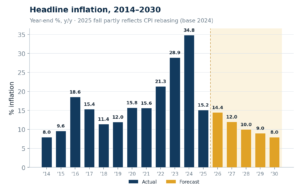
Sources: NBS, APPNL Research
There are a couple of things that stop me from getting too excited. Firstly, the small increase in prices between March and May wasn’t because the reforms didn’t work, but because of something that happened outside of the country – the troubles in the Middle East and the issues between the US, Israel, and Iran [Strait of Hormuz], which affected the global markets for energy and fertilisers, and in turn, increased costs for transportation and fuel locally. The fact that the tax reforms didn’t make prices go up even more is actually a big achievement, because things like food, healthcare, education, transportation, and power weren’t subject to value-added tax from January onwards. This meant that the feared spike in inflation because of the reforms just didn’t happen.
The reality is that disinflation only slows down the rate at which prices increase, but it doesn’t make up for the loss of purchasing power over the past three years. For instance, if a basket of goods costs 16 percent more this year than it did last year, and it already cost 34.8 percent more two years ago, it’s still unaffordable for the average family. That’s why, despite record revenue flows, organised labour has concluded that people don’t feel like they’re better off. Although the statistics are trending in the right direction, the actual experience of people’s lives is not keeping pace – and when you’re struggling to make ends meet, that delay can feel like a failure. The fact remains that many households are still feeling the pinch, and until they see a tangible improvement in their standard of living, they won’t feel like things are getting better.
Who is the Naira’s Guardian Angel?
One thing that’s really caught people off guard is what’s happening with the currency. After losing up to 41.4 percent of its value in 2024, the naira actually gained about 11.8 percent in 2025, and it’s added another 3.8 percent so far in 2026. By mid-July, it was trading at around ₦1,383 officially. What’s really interesting is that the parallel market, which is often a better indicator of how people really feel about the economy, has gotten a lot closer to the official rate – it’s now only about three percent (3%) different. This is a big deal, because just a year and a half ago, it seemed like a pipe dream that these two rates would ever converge. The governor of the Central Bank has been saying for a while now that there won’t be any devaluation, and for once, it looks like that’s actually happening.
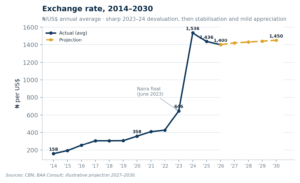
Sources: CBN, APPNL Research
What’s really important is what’s going on behind the scenes, not just the big numbers. The foreign exchange market is getting stronger, with some days seeing over $500 million in trades, and even approaching $1 billion. This means that prices are being set more accurately, and the market is now driven by real factors like oil money, investments, and other economic activities, rather than just rumours and restrictions. The country’s external reserves are also at a 17-year high of $51.45 billion, which is enough to cover imports for almost 14 months – a comfortable cushion against potential oil shocks. This stability allowed the Monetary Policy Committee to lower the policy rate from 27.00 percent to 26.50 percent. And as a result, S&P Global upgraded the country’s rating to ‘B’ in May. It’s no coincidence that the currency is getting stronger, reserves are growing, and the rating is improving all at the same time – it’s a sign that the reforms are finally paying off.
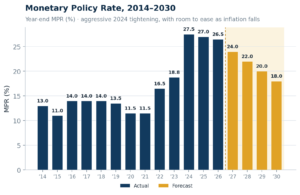
Sources: CBN, APPNL Research
Hot money, cold base (capital flight boarding)
The makeup of the money that came into the country is something we should think about. In Q1-2026, $10.37 billion capital came in, which is 83.83 percent more than the $5.64 billion foreign capital inflow in the similar period of Q1-2025. But $9.86 billion (95%), was from foreign investors who don’t necessarily have a long-term plan in the nation as they only intend to capture gains from the strong appreciation of the naira and opportunities in the money market. The kind of investment that builds factories, hires workers, and stays even when things get tough was very small, making up only 1.3 percent of the total capital inflow. The United Kingdom was responsible for about half of the money that came in, and the banking sector got almost 73 percent of the capital inflow. This is interesting because it shows that most of the money came from outside the country and went to the banks, rather than being used to build new things or create jobs. It’s also worth noting that this kind of investment can be unpredictable and may not always be good for the country in the long run.
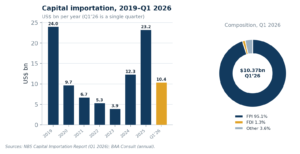
Sources: NBS, APPNL Research
There is no shame in attracting portfolio money; high real yields are doing exactly what they are designed to do, pulling in dollars and steadying the currency. But portfolio flows are, by temperament, a fair-weather friend. They come for the yield and they leave for the yield, and the moment the Monetary Policy Committee begins its inevitable easing — which the projections put at late this year — some of this money will reverse as quickly as it arrived. The reserves that look so reassuring today are, in part, borrowed confidence. The task of the second half, and of the years beyond it, is to convert a trickle of factory-building FDI into a stream. Until the men and women who move real money decide that Nigeria is a place to build rather than merely to park, the external position will remain more fragile than $51 billion makes it look.
Sources: NGX, APPNL Research
The NGX historic Bull Run and the market reality
The stock market had a remarkable run in the first half of the year. It started January at around 156,500 points and shot up to over 228,000 by June, which is a huge gain of nearly 46 percent. The total value of the market also grew significantly, from ₦99.94 trillion to ₦146.56 trillion, that’s an increase of ₦46.6 trillion in just six months. At its peak in mid-May, the market reached an unprecedented ₦160 trillion and the index hit an all-time high above 250,000 points before investors started selling to lock in their profits.
Sources: NBS, APPNL Research
Let’s take a closer look at what happened in June. The correction that wiped out over ₦13 trillion from the peak is worth examining, rather than just brushing it off. When a market keeps going up for five months straight, it’s like a big bubble forming – and the pullback was more like a reality check than a sign of impending doom. The good news is that the rally is built on solid ground, with things like improved sentiment, plenty of domestic liquidity, falling inflation, and a stronger naira all contributing to its success. But investors should keep their feet on the ground and remember that a 46 percent index doesn’t necessarily mean people’s lives are getting better – after all, paper wealth is only worth something until everyone tries to cash out at the same time. It’s essential to separate the numbers from the real-world impact and not get too caught up in the excitement of a rising market.
Current Account majorly driven by trade position
Because my last long read on this economy was built around the foreign-trade ledger, it is only right to return there and see what a year has changed. The Q1 2026 figures from the National Bureau of Statistics extend, almost seamlessly, the story I told about H1 2025. Total merchandise trade stood at ₦34.79 trillion in the first quarter, split between exports of ₦21.17 trillion, or 60.85 percent, and imports of ₦13.62 trillion, or 39.15 percent. The trade surplus came in at ₦7.54 trillion, a remarkable 340.88 percent higher than the ₦1.71 trillion of the preceding quarter.
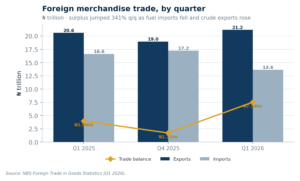
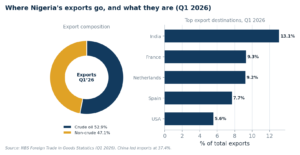
There are two main factors driving this trend, and both are related to policy decisions rather than chance events. The country’s exports saw a significant increase, with a 2.77 percent rise in the first quarter of 2025 and an 11.63 percent jump in the fourth quarter of the same year. Crude oil accounted for a substantial portion of these exports, accounting for ₦11.20 trillion, which is equivalent to 52.92 percent of the country’s total exports. However, what’s even more notable is the growth of non-crude exports, which reached ₦9.96 trillion, or 47.08 percent of the total. This shift towards a more diversified export base is a positive development, indicating that the economy is moving in the right direction, albeit with a still-narrow base that relies heavily on commodities like cocoa, cashew, urea, and gold, rather than value-added goods. The minister of agriculture clearly stated that Nigeria is still going to be bullish on the export of raw materials rather than scrapping it totally for value added goods which is a positive signal for the agricultural trade economics. On the other hand, the country’s imports declined sharply, with an 18.17 percent drop year-on-year and a 21.05 percent decrease quarter-on-quarter. According to the National Bureau of Statistics, this decline can be attributed to a significant reduction in the importation of refined petroleum products, coupled with an increase in crude oil exports. The decrease in fuel imports is a clear indication of the impact of the domestic refining revolution on the national economy, and it represents a major structural shift in the country’s trade data. This development is likely to have far-reaching consequences, and it will be interesting to see how it plays out in the coming months and years.
Our trade landscape has undergone a significant transformation. Notably, India has emerged as Nigeria’s largest export destination, accounting for ₦2.77 trillion, which translates to 13.09 percent of our total exports, surpassing last year’s leaders. Following closely are France, the Netherlands, Spain, and the United States. On the other hand, China continues to be the dominant source of our imports, with a staggering ₦5.09 trillion, or 37.42 percent. However, one aspect that remains unchanged, and which I highlighted a year ago, is the disappointing lack of intra-African trade. We persist in exporting raw materials to European and Asian markets, only to import their finished goods, thereby perpetuating a cycle that enriches other continents at our own expense. Until the African Continental Free Trade Area transitions from mere rhetoric to tangible action, our continent will continue to miss out on opportunities for self-enrichment. The fact that our surplus is largely built on the export of crude oil and cocoa is a fleeting comfort, as it creates a false sense of security for reformers today, while potentially trapping the country in a precarious situation tomorrow.
The tax reform, four Acts, delivers ₦21 trillion
The new tax system had a huge impact on the first half of 2026. It was signed into law on June 26, 2025, and started on January 1, 2026. This new system got rid of six old laws and combined over sixty different taxes and fees into just a few main ones through four new laws: The Nigeria Tax Act, The Nigeria Tax Administration Act, The Nigeria Revenue Service Act, and The Joint Revenue Board Act. The Nigeria Revenue Service Act changed the FIRS into the Nigeria Revenue Service, and the Joint Revenue Board Act also created a Tax Ombud and made the Tax Appeal Tribunal stronger. For a change, a reform in Nigeria actually worked as planned, rather than just being a catchy phrase.
Right from the start, the changes had a big impact on everyone. For instance, people didn’t have to pay taxes on the first ₦800,000 they earned each year, and those who earned the minimum wage were completely exempt from paying taxes. The highest tax rate was set at 25 percent, and there was also a 20 percent reduction in rent, capped at ₦500,000 per year. Additionally, the value-added tax was eliminated on essential items like food, healthcare, education, transportation, and power. Small businesses with an annual turnover of up to ₦100 million were no longer required to pay company income tax, capital gains tax, or the development levy. Instead, a single four percent (4%) Development Levy was introduced for larger companies, simplifying the old system of education and technology levies. Furthermore, big companies with an annual turnover of ₦50 billion or more now have to pay a minimum effective tax of 15 percent, and the capital gains tax rate has been aligned with the company tax rate at 30 percent. Another significant change is that companies can now recover input-VAT on services and fixed assets, which is a big help with their cash flow.
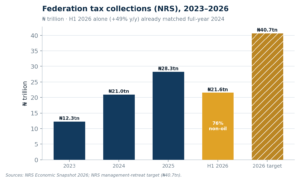
The results have been really impressive. Between January and June, the Nigeria Revenue Service collected a huge amount of money – ₦21.6 trillion, which is 49 percent percent more than they collected during the same time last year. What’s even more significant is that 76 percent of this money came from non-oil sources. In just six months, the new system has already matched the total amount collected in all of 2024. This has led to a big increase in the tax-to-GDP ratio, from 10.3 percent to 13 percent, with a target of 18 percent now in sight. The key to all this is the Rev360 platform, which was launched on April 30, 2026 and has already signed up over 600,000 taxpayers in a matter of weeks. Although the platform got off to a bit of a rough start, even its biggest supporters admit that there’s still work to be done to improve the user experience.
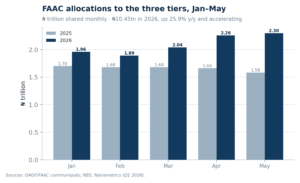
The money from dividends is moving in both directions, up and down. The Federation Account gave out ₦10.45 trillion from January to May, which is 25.9 percent more than the same time last year. And this growth is happening faster and faster – in May 2026, the amount given out was 38.6 percent more than the year before. Something interesting is happening with VAT: it’s now more important for state budgets than the usual allocation of funds. In the first quarter, states got ₦1.28 trillion from VAT, but only ₦0.81 trillion from the usual allocation. Lagos alone got about ₦200 billion, which is a big jump from the ₦124 billion it got the year before. This means that trade and business are now being rewarded in the way funds are shared, which is a big change from how things used to be.
The thing is, people still don’t feel like their lives are getting better. This is the big problem with the changes that are happening – the government is getting better at collecting money, but it’s not using it to make things better for everyone. They’re getting a lot of money, ₦21.6 trillion in just six months, but you can’t see it in the roads, the clinics, or safety on the streets. Until people can see the difference it’s making, they won’t trust that the government is doing the right thing. The government has shown it can collect a lot of money, so now it needs to show what it’s using it for.
| Lens | Evidence (H1 2026) | Status |
|---|---|---|
| Revenue mobilisation | ₦21.6tn, +49% y/y; 76% non-oil | Strong |
| Fiscal federalism | FAAC +25.9%; VAT now outweighs statutory for states | Strong |
| Macro stability | Inflation ~10pp lower y/y; naira firm; reserves 17-yr high | On track |
| Business climate | Recurring burden down; PMI at a one-year high | Mixed |
| Households | Statutory relief delivered; living standards not yet better | Watch |
| Tax administration | Rev360’s rocky debut; ground-level conduct gaps | Watch |
Sources: Forvis Mazars, APPNL Research
Nigeria resource curse likely a blessing to refineries
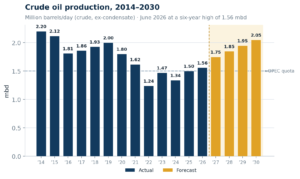
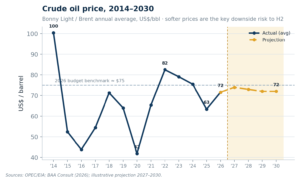
The oil and gas industry had a mixed first half of the year, with some great operational news, but also some frustrating policy issues. On the positive side, crude oil production reached its highest level since April 2020, at about 1.56 million barrels per day in June. When you add in the 0.2 million barrels of condensate, the total production was around 1.76 million barrels per day, which is above the quota set by OPEC and higher than the average for 2021-2024. This was largely due to improved security for pipelines and a real decrease in oil theft, which had a bigger impact than years of trying to address the issue. Additionally, oil prices were favourable, with Nigerian crude averaging around $71.63 per barrel for the first half of the year, which is above the budget benchmark. The government also offered Shell a tax credit of $11.50 per barrel for the Bonga expansion project, which should help keep investment coming in. Overall, it was a good start to the year for the oil and gas sector, but there are still policy challenges to be addressed.
Sources: NUPRC/OPEC, APPNL Research
The Dangote paradox is a puzzling issue that should concern anyone interested in the direction of this economy. Despite the country producing and exporting more crude oil, and importing less refined fuel, the 700,000-barrel-a-day refinery that made this possible is struggling to get the crude it needs to operate efficiently. To run smoothly, the refinery requires between 13 and 15 cargoes of crude every month. However, even after the national oil company increased its domestic allocation to around seven cargoes in May, the deliveries remained inconsistent, held back by loan repayments backed by crude, prior contractual commitments, and production levels that are still below what is required. In a significant move, on July 13, 2026, the refinery stopped using naira for pricing and started quoting prices in dollars instead – $0.779 per litre for petrol, $1.087 for diesel, and $0.942 for jet fuel. This shift to dollar pricing is a notable development, and it raises questions about the refinery’s ability to access the crude it needs to operate effectively. The fact that the refinery is having trouble getting enough crude, despite the country’s increased production and export, is a paradox that needs to be addressed in order to understand the underlying issues in the economy.
Sources: OPEC/EIA, APPNL Research
Let’s take another look at that last sentence, because it’s really important and often gets overlooked in the big picture. When a refinery in our country prices the fuel it produces in a foreign currency, it’s like the refinery is saying that the system we have for paying for crude oil with our own currency, the naira, is no longer working. This means that the risk of changes in the exchange rate is passed directly to the people buying fuel, and from there it affects the cost of getting things from one place to another, which in turn contributes to the inflation that the reforms are trying so hard to control. There are key issues in the midstream sector of the Nigerian oil and gas industry, including companies having too much power, making too much money from refining, and using old prices from September 2024 as a benchmark, which is uncomfortable to hear but true. Just like Dan Kunle said, “If a refinery isn’t refining, it’s not an asset, it’s a liability.” But the bigger concern now is the opposite: a refinery that is working but can’t get the crude oil it needs becomes a problem for everyone who relies on it.
Is Nigeria’s $1trn economy dream in Wonderland
This all takes me back to something I’ve talked about before – the government’s goal of having a one-trillion-dollar economy by 2030. I’m not questioning their ambition, but I do have doubts about the numbers. If our economy is growing at 3.89 percent and might reach 4.1 percent to 4.6 percent by the end of the year, it’s hard to see how we’ll become a trillion-dollar economy in just four years without experiencing double-digit growth, which is something Nigeria has never been able to sustain. The private sector is supposed to provide most of the investment needed, but the government is sending mixed messages – on one hand, they’re telling people to start small businesses, like selling food from a frying pan or a grill, but on the other hand, they’re not doing enough to remove the obstacles that prevent these small businesses from growing into something bigger.
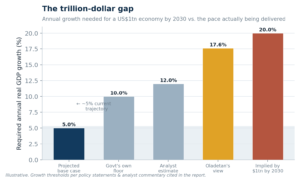
Sources: APPNL Research
For months, nothing has changed. The cost of borrowing is too high, the amount of collateral required is unreasonable, and almost none of the over ₦100 trillion available in the capital market is being used to help small businesses, which are the ones that employ most Nigerians. The lack of reliable power is still a major obstacle to success, which is why many people, like the trader in Kano, are turning to solar panels and planning to disconnect from the grid. The constant changes in the value of the currency make it impossible to plan for the future when it comes to buying machinery and supplies from other countries. The bureaucracy is also a hindrance to entrepreneurs who want to do things the right way. A strong economy is not built by millions of small businesses that are not allowed to grow beyond their current size. Instead, it is built by thousands of medium-sized companies that were once small but were given the opportunity to expand. We are good at supporting new businesses, but we are not good at helping them grow and succeed. Until this changes, our goals will continue to be pushed back and our slogans will continue to be repeated. We need to focus on creating an environment that allows businesses to grow and thrive, rather than just celebrating new start-ups. This is the only way we can build a strong and sustainable economy.
2026 Second Half: Momentum or mirage?
So where does the second half take us? The consensus among the serious forecasters is cautiously bullish, and I broadly share it. Most experts have projected that the GDP growth should be between 4.1% – 4.5%, inflation easing around the corridor of 15.0%, the policy rate edging down to 26.00% with room to cut further in Q4-2026, the naira around ₦1,400 to the dollar, crude near $76.54, oil production above 1.7 million barrels-per-day and reserves rising toward $53.00 billion. The direction of travel, across scholars’ publications and analysts’ deduction is a positive outlook.
But a base case is only as good as the assumptions holding it up, and three of those assumptions are exposed.
The first is oil. Both the fiscal arithmetic and the currency outlook lean on prices staying firm, and a softer barrel — always possible given tenuous global demand and OPEC+ supply decisions — would strain the ₦40.7 trillion full-year revenue target, which already requires the second half to out-collect the first.
The second is geopolitics: the Middle East remains the swing factor for energy and fertiliser prices, and another flare-up would import inflation whether or not our own reforms are working.
The third is the very portfolio money that has propped up the reserves; as the easing cycle begins, some of it will leave, and the reserves cushion is thinner than it looks once you strip out the hot money.
On tax, the second half is the real examination. Meeting the ₦40.7 trillion target means H2 must beat H1 with a possibly weaker oil price behind it. E-invoicing is being widened beyond the largest taxpayers toward the mid-market and eventually the SMEs, which will test both the system and the goodwill. Rev360 must move from a rocky debut to dependable utility. The first full filing season for the 2026 financial year — falling due in 2027 but shaped by what happens now — will stress-test minimum-tax top-ups, new capital-gains positions and worldwide-income disclosures for the first time. And the states must publish and enforce the harmonised levy schedules that are the reform’s last mile for small business. The monetary hand-off, meanwhile, is delicate but favourable: with the policy rate at 26.50 percent against inflation near 16 percent, real rates are strongly positive, which gives the Committee genuine room to ease into 2027 if the fuel shock fades — provided it does not ease so fast that it spooks the portfolio investors keeping the naira aloft.
Defensive or Offensive tactics in 2026 Second Half?
If I were asked to compress the H2 agenda into the handful of things that would actually move the dial, I would start where the pain is sharpest. Fix crude supply to the domestic refineries, and price that crude for local refining below the international price so that the saving reaches the pump rather than the margin; the alternative, fuel quoted in dollars, quietly re-imports the very inflation we are fighting. Force competition into the midstream, because monopoly there will undo the subsidy removal’s promised efficiency. Index pump-head prices to domestic incomes, and monitor and enforce it, rather than leaving prices sticky on the way down. Ring-fence a defined share of oil earnings for agriculture and food security, because affordability, not availability, is now the binding constraint on the average table.
Beyond oil, the priorities write themselves from the data. Turn the record revenue into visible service delivery fast, because the trust gap is the single biggest threat to the reform’s legitimacy — a government that collects ₦21.6 trillion and shows nothing for it invites the backlash. Court patient FDI as deliberately as we have courted portfolio flows, and put the ₦100-trillion-plus capital market to work for the small and medium firms that actually employ Nigerians, instead of parking it endlessly in government paper. Sustain the tax incentives that lifted crude output and extend them to critical manufacturing. And treat macro-stability itself — a predictable naira, a steady disinflation — as the cheapest and most powerful form of support the state can offer the productive economy, because a business that can plan is a business that can grow.
| Indicator | 2025A | 2026F | 2027 | 2028 | 2029 | 2030 |
|---|---|---|---|---|---|---|
| Real GDP growth (%) | 4.03 | 4.59 | 4.7 | 4.9 | 5.1 | 5.3 |
| Inflation, year-end (%) | 15.15 | 14.45 | 12.0 | 10.0 | 9.0 | 8.0 |
| Monetary Policy Rate (%) | 27.00 | 26.00 | 24.0 | 22.0 | 20.0 | 18.0 |
| Exchange rate (₦/$, avg) | 1,436 | 1,415 | 1,420 | 1,430 | 1,440 | 1,450 |
| External reserves ($bn) | 45.5 | 52.2 | 53.5 | 55.0 | 56.5 | 58.0 |
| Oil production (mbd) | 1.50 | 1.60 | 1.75 | 1.85 | 1.95 | 2.05 |
| Oil price ($/bbl, avg) | 63.4 | 76.5 | 74 | 73 | 72 | 72 |
Sources: NBS, CBN, NUPRC, APPNL Research
Half-time scorecard
Nigeria enters the second half of 2026 in the best macroeconomic shape it has been in for years, and it would be churlish to pretend otherwise. Growth is up, inflation is down, the naira is firm, the reserves are full, the market is buoyant and the revenue is pouring in. The reform thesis, so painful in 2023 and so unconvincing in 2024, is finally posting the kind of numbers its defenders always insisted were coming. Anyone reviewing the scoreboard alone would call this a comfortable lead.
But an economy is not a scoreboard, and half-time is not full-time given that there may not be extra-time or penalty shootout. The revenue machine is transforming faster than public trust is forming; the reserves are fuller than they are safe; the growth is real but not yet felt; and the flagship refinery now prices fuel in a currency the average Nigerian does not earn. The assignment for the second half is not to produce prettier numbers — those are already here. It is to make the numbers mean something in the one place they have not yet reached: the household. Reforms that dazzle the analyst and elude the citizen are reforms living on borrowed time. Nigeria has bought itself, with real effort and real pain, a genuine chance to close that gap. Whether it does is the story of the second half — and, honestly, the only story that will matter when the year is finally scored.

Oluwatosin Oladetan, (MBA, ACCA, PMP, FMVA, BIDA, MICBC, CNSS, SPY-SP, NIM, TRCN), a vice president (finance), public policy expert, corporate and business strategist, independent director, trusted advisor, is a Volunteering Contributing Analyst with Business a.m.