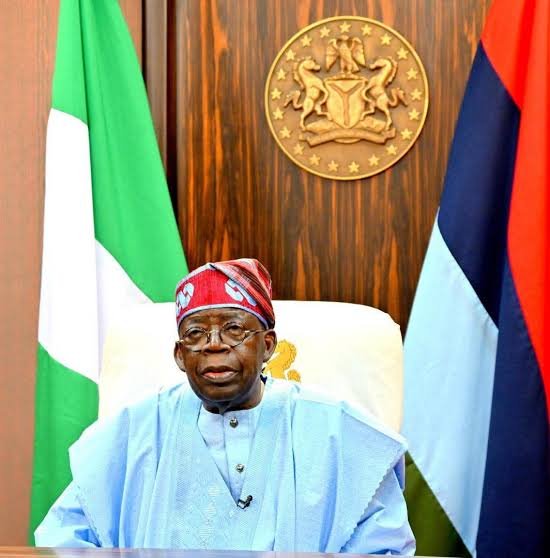
President Bola Ahmed Tinubu has declared that Nigeria is moving into what he called an “age of prosperity”, as he maintains that his administration is shifting its economic focus from stabilising the economy and implementing difficult reforms to driving production, investment, jobs and lower living costs.
In his Independence Day address marking 66 years of Nigeria’s independence, Tinubu said the government had completed the initial phase of correcting economic distortions and would now concentrate on translating those reforms into broader prosperity for households and businesses.
“The emergency treatment is over. The foundation has been repaired. The central economic task before us has changed. Now, our purpose is simple: shared and widespread prosperity,” Tinubu stated.
The president said the next phase of economic policy would centre on reducing the cost of producing and moving goods, expanding agricultural output, supporting industrial activity and improving access to infrastructure and finance.
His declaration comes as households and businesses continue to contend with elevated living and operating costs, while the government seeks to use reforms implemented since 2023 as a platform for stronger and more broad-based economic growth.
Tinubu said lowering the cost of living would require tackling the underlying costs faced by farmers, manufacturers, transport operators and other businesses rather than relying solely on measures that address consumer prices.
He pointed to plans to expand mechanised irrigation and dry-season farming, improve access to seeds and fertiliser, increase agricultural mechanisation and invest in storage and transportation.
The administration also intends to accelerate infrastructure connecting production centres to markets, including roads, railways and ports.
“When a farmer produces more cheaply, when fewer crops are lost between the farm and the market, when a manufacturer spends less on electricity, when a truck reaches its destination faster, and when the business environment fosters fair competition, all those savings will ultimately find their way into the price of goods in the market,” the president said.
Tinubu also identified job creation and industrial expansion as key priorities, with Nigeria’s young population expected to provide a growing labour pool for businesses.
The president said the government would deploy the country’s gas resources to support new industries, revive factories in established industrial centres, expand digital connectivity and invest in skills demanded by employers.
“We are therefore placing jobs, enterprise, and industrial growth at the heart of our government’s policies,” he said.
He also called for a stronger domestic production base, including more Nigerian-made goods, greater agricultural supply to cities and factories, and increased exports by Nigerian businesses.
The administration’s ambition, he said, extends to supporting technology companies and creating conditions for young Nigerians to build globally competitive businesses.
The president used the address to defend the economic reforms implemented since his administration assumed office, arguing that the measures had confronted structural weaknesses rather than created them.
He described the pre-2023 economy as one in which successive governments had postponed difficult decisions and relied on arrangements that he said had become unsustainable.
“By 2023, poverty was rising, and hope was nearly gone. The country’s situation was darker than ever. We had no choice but to act,” Tinubu said.
Using a medical analogy, the president likened Nigeria’s economic challenges to a serious illness requiring painful treatment, arguing that the costs associated with reform should not be confused with the structural problems the measures were designed to address.
Tinubu said his administration had chosen to “excise the cancer”, acknowledging that the resulting reforms had produced real economic side effects.
According to the president, Nigeria’s economy has grown by more than four percent this year, with both oil and non-oil sectors contributing to growth.
He also said oil theft had declined, inflation had fallen substantially from its peak, foreign reserves had been rebuilt and the foreign exchange market had stabilised.
Tinubu further said Nigeria recorded more than $6 billion in non-oil export revenue in 2025, describing it as the highest level in the country’s history.
“These are not idle claims,” he said, arguing that international observers, multilateral institutions and private-sector investors had recognised improvements in the country’s economic stability and resilience.
While shifting emphasis towards production and prosperity, Tinubu acknowledged that millions of Nigerians continue to face pressure from food costs, education expenses, healthcare bills and transportation costs.
He said the government would continue strengthening direct support for vulnerable households while improving the National Social Register to better target assistance.
The administration is also relying on the Nigerian Education Loan Fund to expand access to higher education financing and on CREDICORP to provide consumer credit for assets including vehicles, solar systems and digital devices.
Tinubu said these interventions were intended as a bridge towards greater economic opportunity rather than a substitute for growth.
“Our objective is not to manage poverty more efficiently. We will defeat it,” he said.
He acknowledged that reversing decades of low productivity, infrastructure deficits and limited economic opportunity would take time, but argued that the country could now pursue poverty reduction from what he described as a stronger economic foundation.