The United States Government has awarded a $125,000 grant to the Center for Memories in Enugu to support the digital documentation and physical preservation of Nigeria’s historic Lejja Iron-Smelting Site, in a move the US says could strengthen cultural ties and create economic opportunities around heritage preservation.
The grant, awarded under the U.S. Ambassadors Fund for Cultural Preservation (AFCP), will fund the Nchekwaba: Lejja Iron-Smelting project, which will focus on conservation, three-dimensional digital documentation and physical preservation of the archaeological site in Enugu State.
Dating to approximately 2000 BC, the Lejja site provides evidence of ancient technological innovation and iron-working in Nigeria.
The project is being implemented by the Center for Memories and led by Iheanyi Igboko, a U.S. exchange alumnus. It is linked to the Cultural Heritage Forward programme, funded by the US Department of State in partnership with the Smithsonian Institution.
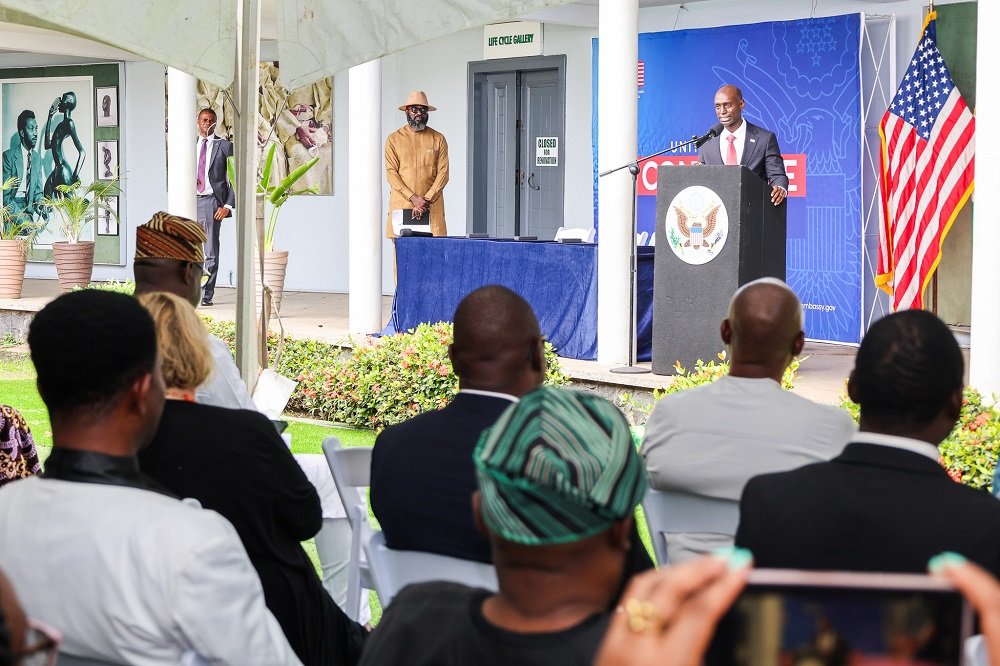
Speaking at the project launch in Lagos, Brandon Hudspeth, U.S. consul general described Lejja as a 4,000-year-old record of technological sophistication, ingenuity and innovation.
He said the latest funding builds on a broader US-Nigeria partnership aimed at preserving the country’s cultural heritage.
“The United States has invested approximately $1.2 million in cultural heritage preservation projects in Nigeria over the past five years, primarily through the Ambassadors Fund for Cultural Preservation.
“This is not aid — this is a strategic economic intervention that advances the interests of Americans, Nigerians, and the global community,” Hudspeth said.
The US government’s framing of the grant as an economic intervention highlights the growing link between cultural heritage, tourism, local economic development and international cooperation.
Preserving sites such as Lejja could help create opportunities around cultural tourism, research, heritage education and local enterprise while safeguarding archaeological assets for future generations.
The project will also seek to preserve the living heritage associated with Lejja, including oral histories, traditions and community knowledge, rather than focusing exclusively on its physical archaeological remains.
Igboko, executive director of the Center for Memories, said the project was not about discovering Lejja but about bringing existing community knowledge and research together within a stronger institutional and technical framework.
“Lejja was not discovered by this project – the community was already there, the researchers were already there, and the knowledge was already there.
“Our role is to bring these efforts together and build the institutional and technical framework through which Lejja can be preserved and shared with the world,” he said.
A key component of the project will be the three-dimensional digital documentation of the site.
Digital preservation can provide researchers and heritage professionals with detailed records of archaeological structures and artefacts while creating new ways for the public to engage with sites that may be difficult to access physically.
The project will connect Nigerian heritage professionals with technical expertise through the Cultural Heritage Forward programme, which brings together Smithsonian experts, Nigerian museum professionals and community-based heritage practitioners.
The year-long programme is designed to facilitate knowledge exchange, strengthen professional networks and improve the capacity of Nigerian institutions and communities to preserve cultural heritage.
The two countries signed a Cultural Property Agreement in 2022, which restricts the importation into the US of certain Nigerian archaeological and ethnological materials.
The agreement is intended to help combat the looting and trafficking of Nigerian cultural property while strengthening cooperation between law enforcement agencies and cultural institutions.
The US Mission has recently begun discussions with Nigerian officials on extending the agreement for another five years, signalling Washington’s continued interest in protecting Nigerian cultural heritage.