Business A.M
No Result
View All Result
Thursday, October 8, 2026
  • Login
  • Technology
  • Finance
  • Comments
  • Companies
  • Commodities
  • ONLINE & DIGITAL CONTENT PACKAGE
Subscribe
Business A.M
  • Technology
  • Finance
  • Comments
  • Companies
  • Commodities
  • ONLINE & DIGITAL CONTENT PACKAGE
No Result
View All Result
Business A.M
No Result
View All Result
Home Technology

Google expands AI-driven search to Africa

by Onome Amuge
August 25, 2025
in Technology
Google expands AI-driven search to Africa

Onome Amuge

Google has launched a new artificial intelligence–driven feature in its search engine for users in Nigeria, Kenya and South Africa, in a push to deepen engagement in fast-growing digital markets.

The feature, branded AI Mode, is designed to handle more complex, multi-part questions and allows users to interact with search using text, voice or images. It is powered by a customised version of Google’s Gemini 2.5 model, which the company says enhances reasoning and contextual understanding.

Alex Okosi, managing director for Google Africa, said the update would reimagine the search experience by enabling more intuitive and exploratory queries. “With AI Mode, users will not only find the information they need more easily but will also be empowered to explore a wider range of content,” he added.

A key element of the product is its ability to break down long questions into subtopics, running multiple queries simultaneously to surface more relevant results. Links to external websites will remain prominent in the interface, considered a nod to publisher concerns that AI-driven summaries could reduce web traffic.

The tool will appear as a tab on Google Search results and within its Android and iOS apps. It has been rolled out gradually across the three markets.
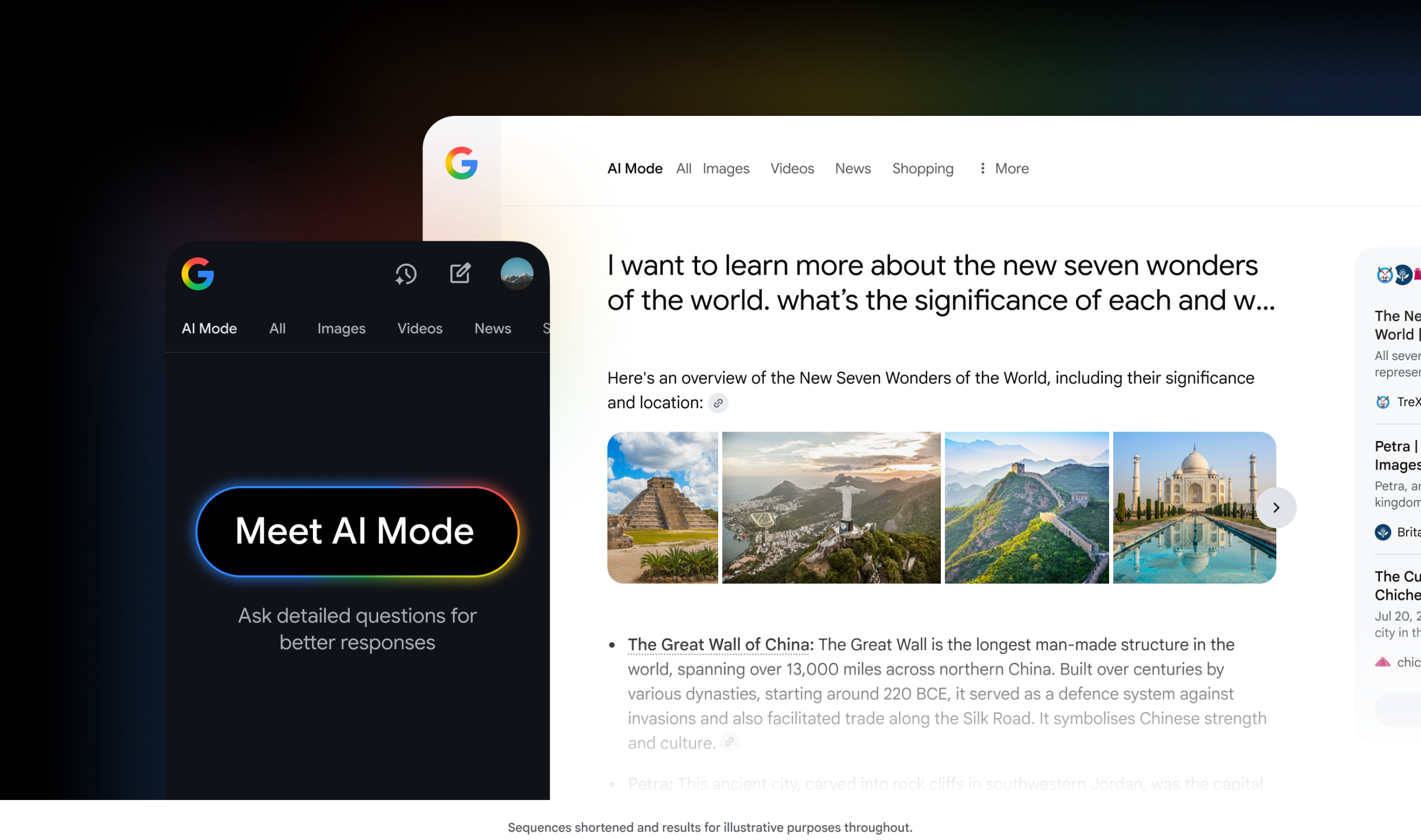
The launch comes as Google and rivals including Microsoft intensify efforts to embed generative AI into core products while balancing regulatory scrutiny and the need to sustain the open web. Data from earlier AI experiments, the company said, indicated that AI-powered overviews encouraged users to visit a greater variety of websites and spend longer on them.


Onome Amuge

Onome Amuge serves as online editor of Business A.M, bringing over a decade of journalism experience as a content writer and business news reporter specialising in analytical and engaging reporting. You can reach him via Facebook ,X and  LinkedIn

Previous Post

Coronation lists N8.8bn infrastructure fund on NGX

Next Post

Equities rebound with N284bn boost as Julius Berger,Cutix fuel rally

Next Post
Equities market bleeds N889bn

Equities rebound with N284bn boost as Julius Berger,Cutix fuel rally

  • Trending
  • Comments
  • Latest

How UNESCO got it wrong in Africa

May 30, 2017

CBN to issue N1.5bn loan for youth led agric expansion in Plateau

July 29, 2025
MMA2 enters new commercial era after 20-year concession dispute

MMA2 enters new commercial era after 20-year concession dispute

August 28, 2026
NGX taps tech advancements to drive N4.63tr capital growth in H1

Insurance-fuelled rally pushes NGX to record high

August 8, 2025

6 MLB teams that could use upgrades at the trade deadline

Top NFL Draft picks react to their Madden NFL 16 ratings

Paul Pierce said there was ‘no way’ he could play for Lakers

Arian Foster agrees to buy books for a fan after he asked on Twitter

Developing economies risk missing global services boom, UNCTAD warns

Developing economies risk missing global services boom, UNCTAD warns

October 8, 2026
Please construct a Business A.M. frontpage business journalism story from this “The growing use of services across all sectors means they should also be viewed as critical for goods exports, a report from the United Nation’s trade and development arm has said. The UN Conference on Trade and Development (UNCTAD) found that industries across the board are increasingly embedding services in their products, even if they traditionally export physical goods. Business models are also changing, as firms look to “bundle services with their products” or move to sell services for goods, such as maintenance contracts. Services increased their overall share of global exports by four percentage points to 27% between 2015 and 2025. Over the past decade, services exports have also grown faster than goods exports, rising by around 6.7% each year. In 2025, services exports increased by 8.3%. This has been driven in part by digitally deliverable services, which UNCTAD said is “the fastest-growing segment of global trade”. These include services that can be “delivered remotely over computer networks”, such as financial and insurance services. The role played by intangible economic activities means that they now “should be viewed not only as a sector in their own right but also as critical inputs into the production and export of goods”, UNCTAD said. “The quality, cost and availability of services directly affect competitiveness and participation in global value chains across all sectors.” Yet developing economies have not benefitted equally, with services exports for these countries growing by just 3% annually. The report said that “poor connectivity, costly cross-border payments and skills gaps”, as well as a lack of data to assess the impact of services within trade overall, are all barriers facing developing economies. Developing economies have a far lower share of digitally deliverable services, accounting for just 16% of total services exports compared to developed economies, which have a share of 61% in 2024. This is due not only to weaker connectivity, but also “diverging export structures”, as developing countries rely on “traditional services such as transport and travel,” rather than digital services, the report said. AI may also widen the divide between countries, it added, with less than a third of developing countries having so far adopted national AI strategies. UNCTAD also noted that multilateral rules have not kept up with digital trade, and regional and bilateral agreements have led to greater regulatory complexity. “Developing countries need better data, stronger digital infrastructure and greater capacity to shape emerging rules,” it said. “Realising the development potential of services trade will require action on three fronts: better data, stronger digital foundations, and more inclusive international co-operation.” Participants in a recent GTR roundtable held in Singapore discussed why services trade may be the market’s next major opportunity. One banker described services trade as “one area that’s really growing, and one area that most banks are underestimating the potential for business”. Earlier this year, UNCTAD found that merchandise trade growth is expected to fall by as many as 3.2 percentage points in 2026 compared to last year. This was down to trade uncertainty and geopolitical tensions weighing on supply chains, shipping and investment decisions, researchers said.

Africa’s trade ambition runs faster than systems built to support it

October 8, 2026
Firms regain investment appetite as NESG confidence index climbs

Firms regain investment appetite as NESG confidence index climbs

October 8, 2026
One Gidi Night shows growing commercial value of Nigeria’s creative economy 

One Gidi Night shows growing commercial value of Nigeria’s creative economy 

October 8, 2026

Popular News

  • How UNESCO got it wrong in Africa

    0 shares
    Share 0 Tweet 0
  • CBN to issue N1.5bn loan for youth led agric expansion in Plateau

    0 shares
    Share 0 Tweet 0
  • MMA2 enters new commercial era after 20-year concession dispute

    0 shares
    Share 0 Tweet 0
  • Insurance-fuelled rally pushes NGX to record high

    0 shares
    Share 0 Tweet 0
  • Glo, Dangote, Airtel, 7 others prequalified to bid for 9Mobile acquisition

    0 shares
    Share 0 Tweet 0
Currently Playing

CNN on Nigeria Aviation

CNN on Nigeria Aviation

Business AM TV

Edeme Kelikume Interview With Business AM TV

Business AM TV

Business A M 2021 Mutual Funds Outlook And Award Promo Video

Business AM TV

Recent News

Developing economies risk missing global services boom, UNCTAD warns

Developing economies risk missing global services boom, UNCTAD warns

October 8, 2026
Please construct a Business A.M. frontpage business journalism story from this “The growing use of services across all sectors means they should also be viewed as critical for goods exports, a report from the United Nation’s trade and development arm has said. The UN Conference on Trade and Development (UNCTAD) found that industries across the board are increasingly embedding services in their products, even if they traditionally export physical goods. Business models are also changing, as firms look to “bundle services with their products” or move to sell services for goods, such as maintenance contracts. Services increased their overall share of global exports by four percentage points to 27% between 2015 and 2025. Over the past decade, services exports have also grown faster than goods exports, rising by around 6.7% each year. In 2025, services exports increased by 8.3%. This has been driven in part by digitally deliverable services, which UNCTAD said is “the fastest-growing segment of global trade”. These include services that can be “delivered remotely over computer networks”, such as financial and insurance services. The role played by intangible economic activities means that they now “should be viewed not only as a sector in their own right but also as critical inputs into the production and export of goods”, UNCTAD said. “The quality, cost and availability of services directly affect competitiveness and participation in global value chains across all sectors.” Yet developing economies have not benefitted equally, with services exports for these countries growing by just 3% annually. The report said that “poor connectivity, costly cross-border payments and skills gaps”, as well as a lack of data to assess the impact of services within trade overall, are all barriers facing developing economies. Developing economies have a far lower share of digitally deliverable services, accounting for just 16% of total services exports compared to developed economies, which have a share of 61% in 2024. This is due not only to weaker connectivity, but also “diverging export structures”, as developing countries rely on “traditional services such as transport and travel,” rather than digital services, the report said. AI may also widen the divide between countries, it added, with less than a third of developing countries having so far adopted national AI strategies. UNCTAD also noted that multilateral rules have not kept up with digital trade, and regional and bilateral agreements have led to greater regulatory complexity. “Developing countries need better data, stronger digital infrastructure and greater capacity to shape emerging rules,” it said. “Realising the development potential of services trade will require action on three fronts: better data, stronger digital foundations, and more inclusive international co-operation.” Participants in a recent GTR roundtable held in Singapore discussed why services trade may be the market’s next major opportunity. One banker described services trade as “one area that’s really growing, and one area that most banks are underestimating the potential for business”. Earlier this year, UNCTAD found that merchandise trade growth is expected to fall by as many as 3.2 percentage points in 2026 compared to last year. This was down to trade uncertainty and geopolitical tensions weighing on supply chains, shipping and investment decisions, researchers said.

Africa’s trade ambition runs faster than systems built to support it

October 8, 2026

Categories

  • Frontpage
  • Analyst Insight
  • Business AM TV
  • Comments
  • Commodities
  • Finance
  • Markets
  • Technology
  • The Business Traveller & Hospitality
  • World Business & Economy

Site Navigation

  • Home
  • About Us
  • Contact Us
  • Privacy & Policy
Business A.M

BusinessAMLive (businessamlive.com) is a leading online business news and information platform focused on providing timely, insightful and comprehensive coverage of economic, financial, and business developments in Nigeria, Africa and around the world.

© 2026 Business A.M

Welcome Back!

Login to your account below

Forgotten Password?

Retrieve your password

Please enter your username or email address to reset your password.

Log In
No Result
View All Result
  • Technology
  • Finance
  • Comments
  • Companies
  • Commodities
  • ONLINE & DIGITAL CONTENT PACKAGE

© 2026 Business A.M