AfroFlavour leads cultural diplomacy drive as Lagos hosts South African Heritage Day

Onome Amuge

Nigeria and South Africa may often be cast as rivals for dominance in African politics and business, but this October they will share a stage in Lagos for South African Heritage Day. The festival is being positioned as a reminder that collaboration, not competition, may hold the key to unlocking Africa’s cultural and economic future.

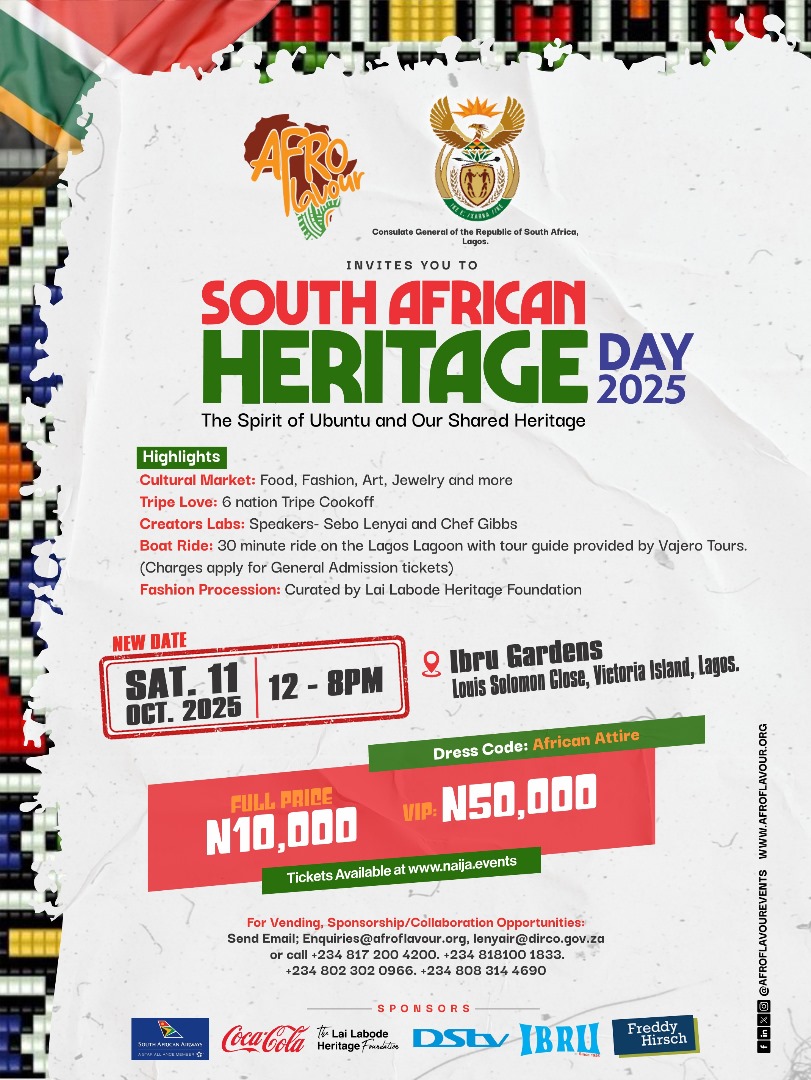
The Heritage Day festival, scheduled for October 11 at Ibru Gardens in Victoria Island, Lagos, is a collaboration between the Consulate and Afroflavour, a pan-African organisation dedicated to promoting African gastronomy worldwide. While it promises the lively energy of tripe cook-offs, jazz performances, and fashion parades, its subtext is unmistakably geopolitical, aimed at deepening South Africa–Nigeria ties at a time when both nations are under pressure to reassert African unity in the global economy.

Heritage Day is traditionally observed in South Africa to celebrate the country’s diverse cultural traditions. Transposed to Lagos, the festival becomes a platform for showcasing South Africa’s cultural identity to Nigerian audiences while emphasising shared histories. South African officials have been quick to highlight Nigeria’s longstanding role in the anti-apartheid struggle, positioning the event as part of a continuing brotherhood.

“Our relations are of brotherhood. We may have our rivalries, but we share more in common than what divides us. Events like this help us tell our own positive stories rather than allow others define our narrative,” Bobby J. Moroe, the Consul-General said at a press briefing. 

That narrative includes economic ambition. By foregrounding African fashion, food, and craft in a Lagos showcase, South Africa is betting on culture as a vehicle for trade, tourism, and investment.

For Afroflavour, founded by entrepreneurs Lucky Idike Jr. and Osa Omoruyi, the Lagos event sits within an intended push to elevate African cuisine and cultural industries globally. Beyond the party atmosphere, the organisation has positioned itself as a business catalyst, staging food festivals and business conferences to connect chefs, farmers, and entrepreneurs with markets at home and abroad.

“This event will promote cooperation and collaboration between Nigeria and South Africa and indeed all of Africa. The AU’s vision for 2063 is of a continent that is self-sufficient, united, and developed. Unity between Nigeria and South Africa is key to achieving that vision,” said Lucky Idike Jr.

(L-R) Betiang Liwhuliwhe Amadeus, creative assistant, Lai Labode Clothing; Chinny Nwokedi, director of operations, Lai Labode Clothing; Sebo Lenyai, chargé d’affaires, South African Consulate General in Lagos; Lucky Idike Jr., founder, AfroFlavour; Charles Akpan, accountant, Lai Labode Clothing; and Lefentse Matlhaga, vice consul (political), South African Consulate General in Lagos.

The Lagos programme mirrors that ambition. Alongside its cultural attractions ranging from the Afroliganza fashion procession to performances of South African jazz, the festival will host discussions on Africa’s future under Agenda 2063, the African Union’s long-term development blueprint.

Another striking feature of the day will be the six-nation tripe cook-off, where chefs from Nigeria, South Africa, Kenya, Ghana, Morocco, and Zimbabwe will compete. Far from being just a culinary contest, organisers present it as an exploration of identity and belonging, showcasing how traditional foods remain deeply tied to cultural pride and economic potential.

South Africa will spotlight mahulu, while Nigeria will serve shaki, dishes that embody both local tastes and opportunities for gastronomic branding. Food, in this context, becomes a medium of diplomacy, connecting people while highlighting economic potential in agriculture, hospitality, and exports.

The festival is also expected to generate direct commercial opportunities. A cultural market featuring Pan-African vendors will give small-scale producers a platform, while tourism operators such as Vajero Tours will provide boat rides on Lagos Lagoon, integrating leisure and business. Ticket sales are set at N10,000 for general admission and N50,000 for VIPs.

Sponsors including Coca-Cola, DSTV, and Freddy Hirsch bring corporate weight, while the involvement of the Lai Labode Heritage Foundation in curating the fashion procession adds cultural legitimacy.

Leave a Comment

AfroFlavour leads cultural diplomacy drive as Lagos hosts South African Heritage Day

Onome Amuge

Nigeria and South Africa may often be cast as rivals for dominance in African politics and business, but this October they will share a stage in Lagos for South African Heritage Day. The festival is being positioned as a reminder that collaboration, not competition, may hold the key to unlocking Africa’s cultural and economic future.

The Heritage Day festival, scheduled for October 11 at Ibru Gardens in Victoria Island, Lagos, is a collaboration between the Consulate and Afroflavour, a pan-African organisation dedicated to promoting African gastronomy worldwide. While it promises the lively energy of tripe cook-offs, jazz performances, and fashion parades, its subtext is unmistakably geopolitical, aimed at deepening South Africa–Nigeria ties at a time when both nations are under pressure to reassert African unity in the global economy.

Heritage Day is traditionally observed in South Africa to celebrate the country’s diverse cultural traditions. Transposed to Lagos, the festival becomes a platform for showcasing South Africa’s cultural identity to Nigerian audiences while emphasising shared histories. South African officials have been quick to highlight Nigeria’s longstanding role in the anti-apartheid struggle, positioning the event as part of a continuing brotherhood.

“Our relations are of brotherhood. We may have our rivalries, but we share more in common than what divides us. Events like this help us tell our own positive stories rather than allow others define our narrative,” Bobby J. Moroe, the Consul-General said at a press briefing. 

That narrative includes economic ambition. By foregrounding African fashion, food, and craft in a Lagos showcase, South Africa is betting on culture as a vehicle for trade, tourism, and investment.

For Afroflavour, founded by entrepreneurs Lucky Idike Jr. and Osa Omoruyi, the Lagos event sits within an intended push to elevate African cuisine and cultural industries globally. Beyond the party atmosphere, the organisation has positioned itself as a business catalyst, staging food festivals and business conferences to connect chefs, farmers, and entrepreneurs with markets at home and abroad.

“This event will promote cooperation and collaboration between Nigeria and South Africa and indeed all of Africa. The AU’s vision for 2063 is of a continent that is self-sufficient, united, and developed. Unity between Nigeria and South Africa is key to achieving that vision,” said Lucky Idike Jr.

(L-R) Betiang Liwhuliwhe Amadeus, creative assistant, Lai Labode Clothing; Chinny Nwokedi, director of operations, Lai Labode Clothing; Sebo Lenyai, chargé d’affaires, South African Consulate General in Lagos; Lucky Idike Jr., founder, AfroFlavour; Charles Akpan, accountant, Lai Labode Clothing; and Lefentse Matlhaga, vice consul (political), South African Consulate General in Lagos.

The Lagos programme mirrors that ambition. Alongside its cultural attractions ranging from the Afroliganza fashion procession to performances of South African jazz, the festival will host discussions on Africa’s future under Agenda 2063, the African Union’s long-term development blueprint.

Another striking feature of the day will be the six-nation tripe cook-off, where chefs from Nigeria, South Africa, Kenya, Ghana, Morocco, and Zimbabwe will compete. Far from being just a culinary contest, organisers present it as an exploration of identity and belonging, showcasing how traditional foods remain deeply tied to cultural pride and economic potential.

South Africa will spotlight mahulu, while Nigeria will serve shaki, dishes that embody both local tastes and opportunities for gastronomic branding. Food, in this context, becomes a medium of diplomacy, connecting people while highlighting economic potential in agriculture, hospitality, and exports.

The festival is also expected to generate direct commercial opportunities. A cultural market featuring Pan-African vendors will give small-scale producers a platform, while tourism operators such as Vajero Tours will provide boat rides on Lagos Lagoon, integrating leisure and business. Ticket sales are set at N10,000 for general admission and N50,000 for VIPs.

Sponsors including Coca-Cola, DSTV, and Freddy Hirsch bring corporate weight, while the involvement of the Lai Labode Heritage Foundation in curating the fashion procession adds cultural legitimacy.

[quads id=1]

Get Copy

Leave a Comment