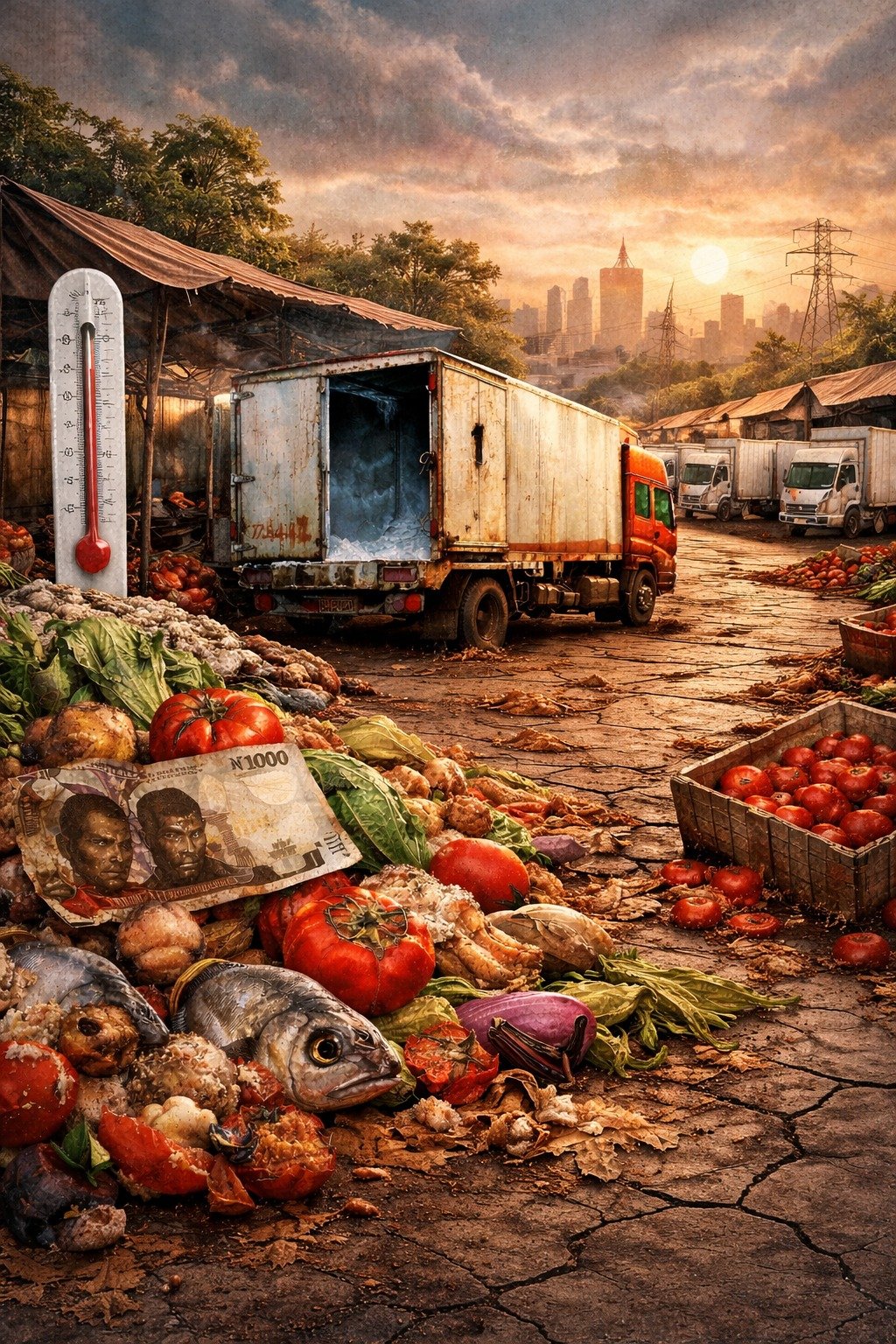
Food security debates in Nigeria have traditionally focused on how much the country produces; hectares cultivated, tonnes harvested and annual output growth. But mounting industry evidence indicates the bigger issue is not production but preservation.
Weak storage systems, poor cold chain infrastructure and inefficient transportation networks mean that large volumes of harvested food never reach markets in usable condition. As a result, Nigeria produces millions of tonnes of food each year that ultimately spoil before they can be consumed.
Industry estimates show that between 30 per cent and 50 per cent of highly perishable crops such as tomatoes, vegetables, fruits and fish are lost annually due to inadequate storage facilities and fragile distribution systems. According to the Food and Agriculture Organization (FAO), as much as 40 per cent of food produced across sub-Saharan Africa is lost between harvest and consumption, reflecting a systemic supply chain weakness across many emerging agricultural economies.
In Nigeria, the economic cost of these inefficiencies is staggering. Recent industry data estimates that the country loses between N3.5 trillion and N5 trillion worth of food every year to post-harvest losses.
These losses represent crops that have already consumed valuable economic resources ; including land, fertiliser, irrigation, labour and transport, yet never translate into revenue or food supply.
“The losses are enormous. In monetary terms, this translates to approximately ₦3.5 trillion to ₦5 trillion in economic losses,” said Alexander Isong, president of the Organisation for Technology Advancement of Cold Chain in West Africa (OTACCWA).
The implications stretch far beyond the agricultural sector. When food spoils before reaching markets, the economy loses not only the crop itself but also the entire value chain investment embedded in its production.
Land preparation, fertiliser application, irrigation systems, labour inputs and transportation costs have already been incurred by the time produce is harvested. When post-harvest loss occurs, the economic value created by those inputs effectively disappears.
Isong argues that the issue should therefore be viewed less as an agricultural problem and more as a structural infrastructure challenge.
Post-harvest loss, he said, represents a breakdown in the systems that connect farms to markets.
“Without certified, functional and scalable cold chain systems, Nigeria will continue to experience food inflation, depressed farmer income and diminished export credibility,” he said.
The consequences of this infrastructure deficit are increasingly visible in Nigeria’s inflation data.
Statistics from the National Bureau of Statistics (NBS) show that food prices remain one of the largest drivers of overall inflation in the country. While factors such as currency depreciation and rising transport costs contribute to price increases, supply shortages linked to post-harvest losses also tighten food availability in markets.
The tomato industry provides a vivid example of the problem. Nigeria produces more than two million metric tonnes of tomatoes annually, according to industry estimates cited by the Central Bank of Nigeria (CBN). Despite this large production base, the country continues to import significant quantities of tomato paste.
The reason is not lack of production, but rather the loss of a large portion of the harvest before it reaches processing facilities or consumer markets.
Industry analysts estimate that up to 40 per cent of Nigeria’s tomato harvest spoils due to poor storage and transportation conditions. The losses create supply gaps that ripple through the food system, pushing prices higher while forcing the country to rely on imports for processed tomato products.
Cold chain infrastructure seen as prominent solution
Agricultural economists increasingly argue that Nigeria’s food security challenge is no longer primarily about increasing production volumes. Instead, the focus must shift toward improving the systems that preserve, transport and distribute food after harvest.
One of the most widely cited solutions is the expansion of cold chain infrastructure.
Cold chains refer to temperature-controlled systems designed to preserve perishable goods from the moment they are harvested until they reach markets or processing plants. These systems typically include refrigerated storage warehouses, cold rooms, refrigerated trucks and digital monitoring technologies that maintain consistent temperature conditions throughout the logistics network.
In advanced agricultural economies, cold chain systems serve as the critical bridge between farm productivity and market profitability.
Countries such as the United States, China, Australia and New Zealand have significantly reduced post-harvest losses by integrating cold storage, processing and logistics technologies into their agricultural value chains.
In contrast, many developing economies, including Nigeria, still rely heavily on informal preservation methods such as open-air transport and rudimentary storage facilities.
According to OTACCWA, Nigeria lost between 30 million and 40 million metric tonnes of food within a single year, largely across highly perishable categories including vegetables, fruits, dairy, fish and root crops.
“The lack of adequate cold storage facilities remains the primary obstacle. Cold chain is an integral part of agriculture, and without sufficient investment, the sector’s growth and potential are severely limited,” Isong said.
Investment gap runs into billions
The scale of Nigeria’s cold chain infrastructure deficit presents both a challenge and a major investment opportunity.
Market estimates indicate that Nigeria’s cold chain sector is currently valued at around N160 billion, yet the country operates fewer than 1,000 refrigerated trucks nationwide.
Industry projections point out that Nigeria requires approximately 25,000 refrigerated trucks to support the movement of more than 11 million metric tonnes of perishable food annually.
Beyond transportation, the country also faces shortages in refrigerated warehouses, pack houses and modern aggregation centres where produce can be sorted, graded and preserved before distribution.
Other market assessments estimate the cold storage and refrigerated logistics sector at about $1.2 billion, with significant growth potential as demand rises for fresh food, pharmaceuticals and modern food retail.
Population growth is expected to intensify this demand.
United Nations projections indicate that Nigeria’s population could exceed 400 million people by 2050, making it one of the world’s most populous nations. Feeding such a population will require not only expanded agricultural production but also a far more efficient national food distribution system.
Export potential remains underdeveloped
Cold chain infrastructure also carries major implications for Nigeria’s export competitiveness.
Despite being one of Africa’s largest agricultural producers, the country captures only a small share of the global fresh produce trade.
According to Opeoluwa Runsewe, chief executive officer of Terroso Group, the absence of reliable temperature-controlled logistics remains a major constraint preventing Nigerian exporters from accessing high-value international markets.
Global fresh produce markets require strict temperature and quality control standards to maintain product freshness during long-distance transport.
Without reliable refrigerated storage and transportation systems, many Nigerian agricultural products cannot meet these standards.
Strengthening cold chain infrastructure could therefore unlock significant export opportunities while improving foreign exchange earnings.
Runsewe explained that Terroso Group has been investing in smart cold storage facilities, refrigerated logistics systems and technology-enabled monitoring platforms designed to reduce post-harvest losses across Nigeria’s agricultural value chains.
“Cold storage should therefore be viewed not simply as a logistics service but as a core element of national economic infrastructure,” he said.
Reducing food waste, stabilising supply chains, improving farmer income and expanding export opportunities all depend on modern agricultural logistics, he added.
Beyond exports, improved cold storage capacity could help stabilise domestic food prices.
Market intelligence from the AFEX Commodities Exchange indicates that seasonal supply disruptions often drive sharp price volatility in agricultural markets.
When crops are harvested in large volumes during peak seasons, prices typically collapse due to oversupply. Conversely, during off-season periods, shortages drive prices sharply higher.
Cold storage facilities allow produce to be preserved for longer periods, smoothing supply cycles and reducing extreme price fluctuations.
This would provide farmers with greater flexibility to sell produce when market conditions are favourable rather than immediately after harvest when prices are lowest.
As Nigeria continues to pursue agricultural transformation and economic diversification, analysts say the government may need to rethink how food security is defined.
For decades, agricultural policy discussions have focused primarily on boosting production. But evidence increasingly show that Nigeria already produces a significant portion of the food required to feed its population.
The bigger challenge lies in ensuring that the food produced survives the journey from farm to market.
For Nigeria’s agricultural sector, the next phase of transformation may therefore depend less on planting more crops, and more on ensuring that the crops already harvested actually reach consumers.
As Runsewe observed, the country’s long-term food security will increasingly depend on its ability to preserve the value of what it already produces.
Nigeria may already grow enough food to feed much of its population, he said, but how effectively that food is stored, transported and distributed will ultimately determine the resilience and competitiveness of its agricultural economy in the decades ahead.