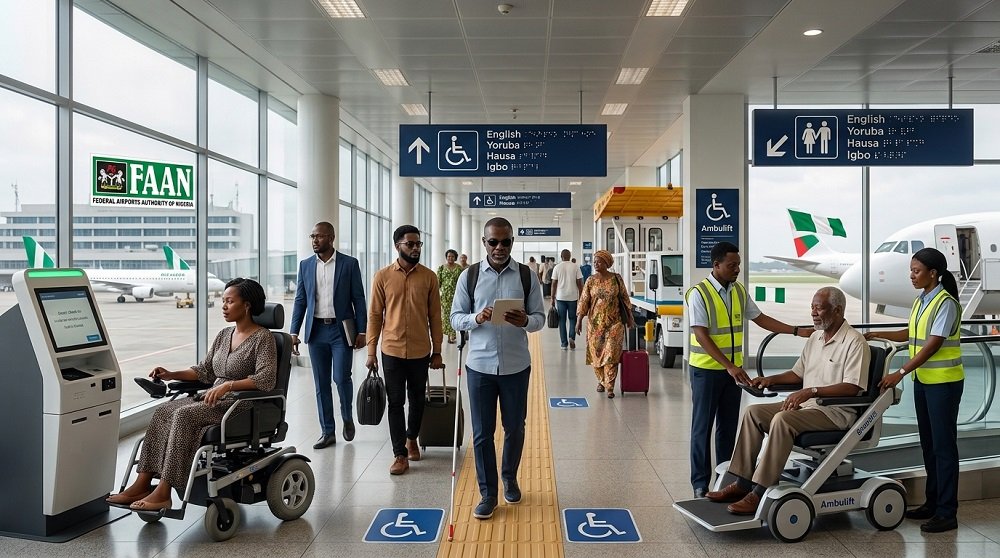
Passengers with disabilities may require assistance at several stages of air travel, from check-in and security screening to boarding, navigating airport terminals and collecting baggage. How smoothly these journeys proceed depends not only on the availability of support services but also on how early passengers can request assistance and how reliably airlines and airport operators deliver it.
The Federal Airports Authority of Nigeria (FAAN) advises passengers requiring special assistance to notify their airlines when booking tickets or contact them directly, preferably at least 48 hours before departure. The authority says making such requests in advance allows arrangements to be coordinated throughout the journey.
However, the effectiveness of this process depends on whether passengers can easily communicate their needs, whether the information reaches the relevant airport personnel and whether the promised assistance is available when required.
The issue has implications for passenger experience and service standards in Nigeria’s aviation industry, where accessibility requires coordination among airlines, airport operators and other service providers.
In January 2026, the Nigeria Civil Aviation Authority (NCAA) reiterated its directive requiring domestic airlines to include a special-needs assistance option on their ticket-booking platforms. The measure is intended to allow passengers to identify their assistance requirements during reservations rather than relying exclusively on subsequent calls or requests at the airport.
Embedding the option in booking platforms could improve the visibility of passengers’ needs before departure and give airlines more time to plan. But the presence of a booking feature does not, by itself, establish that assistance will be delivered consistently at check-in, boarding gates or aircraft arrival points.
The distinction between a policy requirement and its implementation is central to assessing accessibility across the domestic aviation market. Relevant indicators include whether passengers can request assistance without difficulty, whether staff are available at the required stages of travel and how complaints about missed or inadequate support are handled.
Accessibility also extends beyond physical mobility. Some disabilities and conditions are not immediately apparent to airport staff, and passengers may need help managing sensory stimulation, anxiety or unfamiliar environments without requiring a wheelchair or other visible mobility aid.
Heathrow Airport in the United Kingdom offers one example of how airports can address these needs. Its support arrangements include free sunflower lanyards for passengers who wish to discreetly indicate a non-visible disability, alongside sensory packs for passengers who may benefit from them. Such measures complement conventional mobility assistance by helping staff recognise that a passenger may need additional time, communication or support.
The approach highlights a broader consideration for airport operators: accessible travel requires more than infrastructure such as ramps and lifts. Staff awareness, clear communication, suitable facilities and procedures for responding to different needs can also influence whether passengers navigate an airport independently and with dignity.
In Nigeria, discussions between the National Aviation Accessibility Initiative and FAAN in August 2026 brought accessibility challenges and potential practical improvements into focus. The engagement provides a basis for examining how existing arrangements operate and what further measures may be required.
Industry analysts suggest that the next step for the industry is to establish how well existing directives and assistance channels work in practice. This would require clearer information on service availability, staff training, response times, passenger complaints and the consistency of assistance across airports and airlines.
Airlines and airport operators could also strengthen communication by making assistance options more visible during booking, explaining what support is available and providing passengers with a clear point of contact when arrangements change.
For passengers with disabilities, a journey may depend on a sequence of coordinated services rather than one isolated intervention. A request recorded during booking must translate into practical support at the airport, during boarding and, where necessary, on arrival.