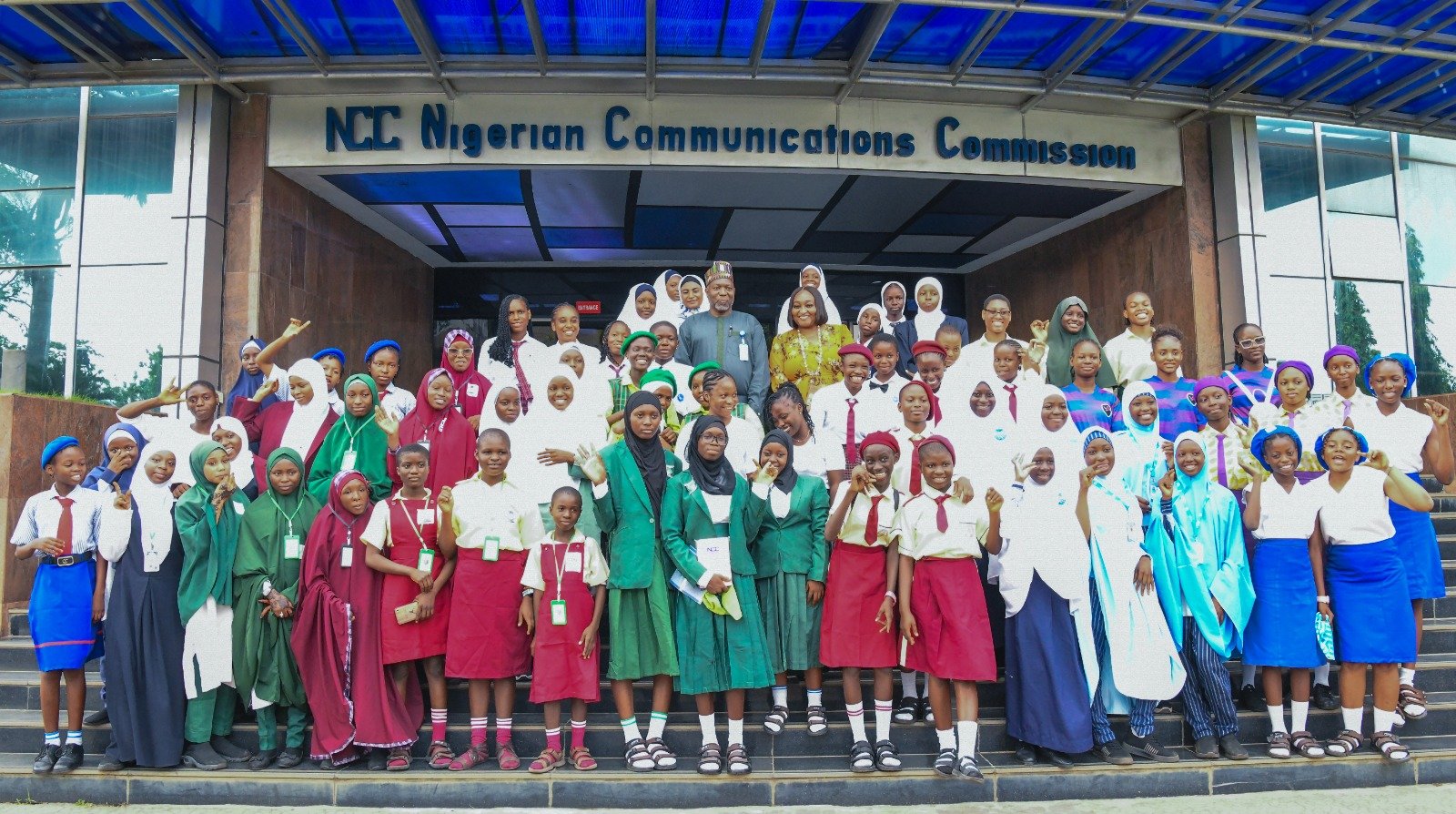
The Nigerian Communications Commission (NCC) has thrown its weight behind ongoing efforts to bridge Nigeria’s gender gap in technology, commending initiatives by the Federal Ministry of Communications, Innovation and Digital Economy aimed at equipping young girls with digital skills and preparing them for future careers in the country’s expanding technology ecosystem.
The endorsement came as the Commission hosted 185 participants in the 2026 National Girls in ICT (NG-ICT) Competition on an educational excursion to the National Communications Museum in Abuja, exposing them to the history and evolution of Nigeria’s telecommunications sector.
The students, drawn from the country’s six geopolitical zones, were selected by the ministry to participate in the competition, which seeks to encourage greater female participation in Information and Communication Technology (ICT) and other Science, Technology, Engineering and Mathematics (STEM)-related fields.
Speaking during the visit, Aminu Maida, the executive vice chairman of the NCC, praised Bosun Tijani,the minister of communications, innovation and digital economy, for spearheading programmes designed to empower young Nigerians, particularly girls, through digital literacy and technological exposure.
Represented by Babagana Digima, the director of Research and Development at the NCC, Maida said the initiative aligns with the Commission’s commitment to promoting digital literacy and nurturing future innovators capable of contributing to Nigeria’s digital economy.
According to him, exposing young girls to technological development and innovation at an early stage is critical to building a pipeline of talent that will drive the country’s digital transformation agenda.
The visit formed part of activities organised under the National Girls in ICT Programme, a national initiative focused on expanding opportunities for girls in technology through skills development, mentorship and direct exposure to innovation-driven environments.
Maida explained that the museum tour was carefully designed to connect the younger generation with the rich history of telecommunications development in Nigeria, while helping them understand how technological advancements have transformed communication over the decades.
“The whole idea behind this is that we are looking at the younger generation. We want to show them what communication is all about,” he said.
“This place is a museum meant to preserve the history of what has gone before and to keep the artefacts, ensuring that people see the evolution from the postal system to telegraphy, from analogue systems to the digital era.”
He noted that understanding the journey of technological advancement could inspire the students to imagine and create future innovations that will shape the next phase of Nigeria’s digital development.
“When they see what happened in the past and how it has progressed into the future, they can also take it up from here and think about what it will look like going forward. That is the whole essence of having them here,” he added.
During the excursion, NCC officials guided the students through various exhibits chronicling key milestones in the country’s communications history, from the colonial era to the modern digital age.
The participants were introduced to the origins of telecommunications in Nigeria, dating back to 1886 when the first communication facilities were established by the colonial administration primarily for administrative purposes.
They also learned about the country’s early telegraph systems, which linked Lagos to other parts of West Africa and Europe through submarine cable networks, laying the foundation for modern communications infrastructure.
The educational tour further highlighted the state of Nigeria’s telecommunications sector at independence in 1960, when the country had only 18,724 telephone lines serving a population estimated at about 40 million people.
Officials also provided insights into the evolution of the sector through various post-independence development plans, including the roles played by the former Department of Posts and Telecommunications (P&T), Nigerian External Telecommunications (NET) Limited and the eventual establishment of the Nigerian Telecommunications Limited (NITEL) in 1985 to coordinate domestic and international telecommunications services.
A major attraction during the visit was the display of rare historical artefacts preserved at the National Communications Museum, many of which offer a glimpse into the technologies that shaped communication in Nigeria over the past century.
Among the items showcased were a post office counter dating back to 1852, sorting racks introduced into Lagos in the same year, the historic Grand “T” Key used at the Lagos Post Office during the nineteenth century, leather mail bags dating back to 1863 and drop bag fittings from the late twentieth century.
The students also viewed a range of communication equipment spanning different technological eras, including telegram machines, teleprinters, digital card phones, cordless private branch exchange (PBX) systems and weighing scales used in postal operations.
The NCC said the programme underscores the importance of preserving the nation’s telecommunications heritage while inspiring a new generation of digital innovators who will help shape the future of Nigeria’s technology sector.
The National Girls in ICT Programme is part of broader efforts by the Federal Ministry of Communications, Innovation and Digital Economy to promote digital inclusion and encourage more girls to pursue careers in technology and innovation, at a time when governments and industry stakeholders are seeking to increase female representation across STEM disciplines.