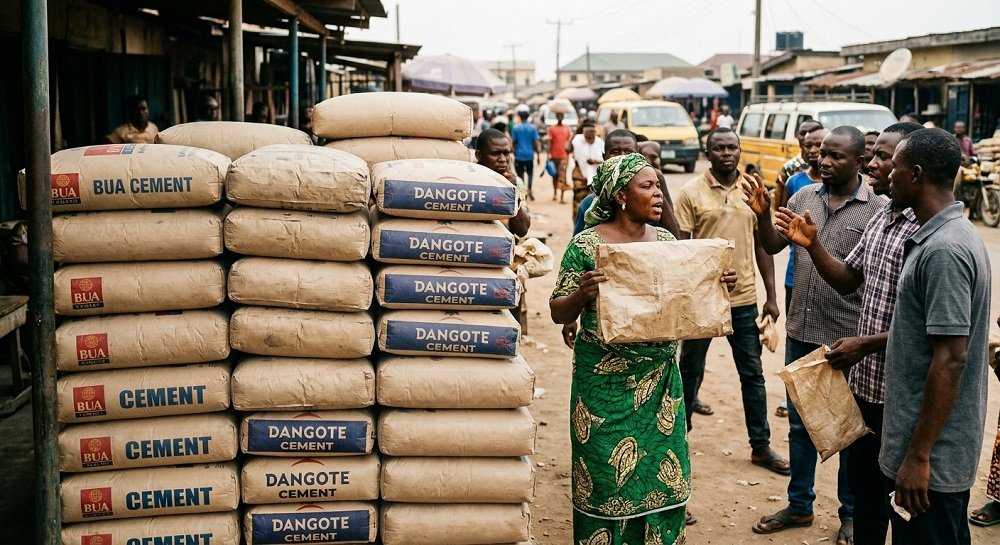
The Federal Competition and Consumer Protection Commission (FCCPC) is testing the economics of Nigeria’s cement industry after a regional market study exposed a widening gap between domestic prices and those in several African countries.
The Commission’s investigation centres on whether legitimate cost increases are sufficient to explain the price of cement in Nigeria, or whether competition problems are allowing manufacturers to sustain higher prices.
According to the FCCPC, a 50kg bag sold for between N9,300 and N9,700 in January 2026. By mid-year, prices had climbed to N10,500-N13,000, before reaching N13,000-N15,000 in some parts of the country by July.
The increases have come despite an estimated Nigerian cement production capacity of 60-65 million metric tonnes a year, compared with domestic consumption of only about 25-30 million tonnes.
In theory, that gap should create a buyer-friendly market. Producers with unused capacity should compete aggressively for customers, putting pressure on prices.
Instead, the Commission says, the opposite appears to be happening.
“Of particular concern to the Commission is that this level of production capacity has not resulted in the downward pressure on domestic prices that might ordinarily be expected in a competitive market with substantial excess capacity,” it said.
The FCCPC’s three-month cross-border assessment provides another reason for scrutiny.
Its preliminary comparison found that Nigerian cement prices were nearly twice those in Kenya and Tanzania. A 50kg bag was estimated at about N7,344 in Nairobi and N6,528 in Tanzania, against as much as N15,000 in parts of Nigeria.
The comparison becomes more striking when production fundamentals are considered.
Kenya, with a population of about 58.6 million, recorded cement demand of approximately 9.3 million tonnes in 2025. Tanzania, with a population of about 66.3 million, recorded a similar level of demand.
Nigeria’s domestic market is substantially larger, but its production capacity is also far greater than its consumption.
The country also has substantial limestone reserves and is a net exporter of cement to neighbouring markets.
Even Togo, which the FCCPC noted lacks significant limestone deposits, recorded a retail price of about N9,180 per 50kg bag in the Commission’s comparison.
The implication is not that Nigerian cement prices should automatically match those of other countries. Rather, the price differences have given the competition regulator grounds to ask whether the cost increases can be fully explained by legitimate market conditions.
Meanwhile, cement manufacturers have pointed to a familiar list of pressures confronting Nigerian industry including rising energy costs, the naira’s depreciation, more expensive imported machinery and spare parts, transportation and logistics expenses.
Those factors can materially raise the cost of production and distribution.
But the FCCPC is now testing those explanations against the companies’ actual records.
Its investigation will examine production costs, capacity utilisation, pricing structures, exports, domestic supply and commercial relationships. The Commission is also investigating possible coordination among producers, abuse of market power, restrictions on domestic supply and potentially anti-competitive distribution practices.
The regulator stressed that it is not attempting to dictate what cement manufacturers can charge or prevent them from earning profits. Its concern is whether the market is producing prices through competition or through conduct that restricts competition.
That puts the focus not simply on how expensive cement is, but on how the price is formed.
The investigation takes place against a highly concentrated industry structure.
Publicly available estimates indicate that three major companies account for more than 90 per cent of Nigeria’s installed cement production capacity.
Such concentration does not, by itself, establish wrongdoing. Large companies can achieve economies of scale and remain subject to competitive pressure even in concentrated markets.
But it can make questions about pricing, market access and commercial coordination more consequential, particularly when prices move sharply in a market carrying substantial excess capacity.
The FCCPC has therefore issued Notices of Commencement of Investigation and Summons to Produce to key industry players, requiring them to provide records covering pricing methods, production volumes, capacity utilisation, exports and commercial relationships.
The Commission said all major manufacturers had cooperated with requests for records except one company.
Why the investigation matters beyond cement
The stakes extend well beyond the cement industry.
Cement is one of the most important inputs into Nigeria’s housing and infrastructure markets. Higher prices feed directly into construction costs, affecting developers, contractors, governments and ultimately households trying to build or buy homes.
For a country already struggling with a housing deficit and high infrastructure costs, the difference between a competitive cement market and a distorted one can have economy-wide consequences.
Tunji Bello, FCCPC chief executive, said cement’s strategic importance justified a closer examination of how the market operates.
The Commission’s preliminary findings do not establish that manufacturers have engaged in price fixing or any other prohibited conduct. They establish, rather, that the regulator believes there are sufficient grounds to investigate.
That distinction will be critical as the process unfolds.
The manufacturers may be able to prove that higher prices reflect higher costs, currency movements, energy expenses, logistics and other legitimate factors. Alternatively, the Commission could find evidence that market power or coordinated behaviour has contributed to prices.