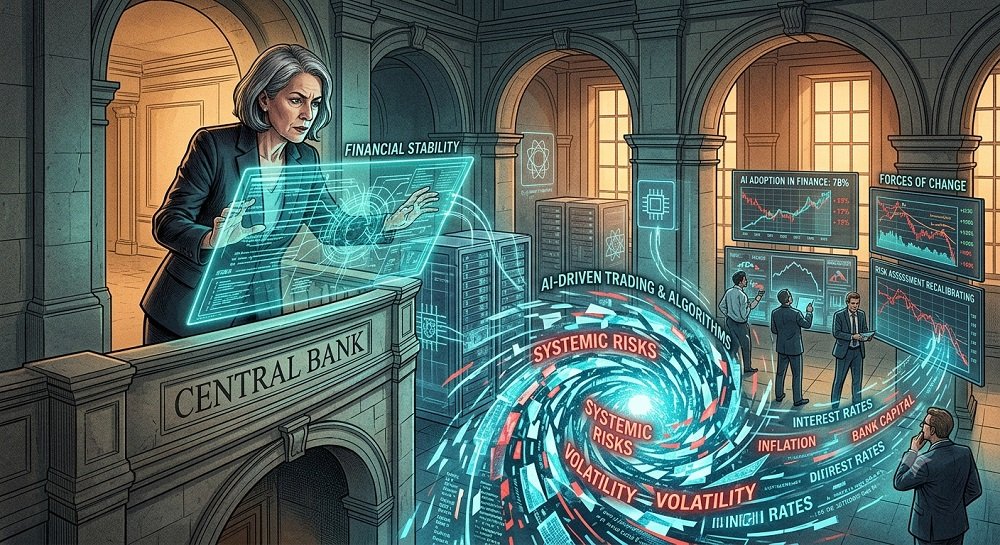
Central banks and financial supervisors across nations face the key challenge of how to contain financial stability risks by ensuring that Artificial Intelligence (AI) is governed in ways that strengthen financial stability rather than undermine it, according to an expert analysis by the International Monetary Fund (IMF).
The IMF expert analysis says three priorities have been pushed out for central banks and supervisors, namely to strengthen oversight and governance of AI‑driven trading, lending, and supervisory technology (known as SupTech); improve visibility into AI use, dependencies, and asset correlation risks due to synchronized trading strategies; and to deepen international cooperation on operational resilience and cyber defense.
The IMF expert analysis noted that AI compresses time and distance in finance, potentially reshaping how financial firms price risk, allocate credit, and respond to stress, adding that it is increasingly embedded in the decision‑making architecture of the financial system.
Since trading, credit decisions, and supervisory analytics increasingly occur in real time, changing how shocks spread and how quickly they can become systemic, the responsibilities for market functioning, financial stability, and operational resilience are becoming increasingly rooted with AI policy and governance choices, it stated.
The IMF expert analysis observed that some AI‑based funds rebalance much faster than traditional strategies, amplifying swings when many models respond to similar signals.
“Herding is not new, but AI can change its dynamics. Future flash crashes may arise less from coding errors and more from many AI systems reacting in parallel to the same information,” it further noted.
The expert analysis from the Bretton Woods institution further warns that opacity (or cloudiness by financial authorities) adds another challenge, adding that even sophisticated institutions can struggle to explain why an AI‑based strategy behaved as it did under stress, making it harder for central banks and financial supervisors to detect emerging risks and diagnose market disruptions.
The IMF analyst Tobias Adrian said policies need to catch up. Central banks and financial supervisors will have to monitor AI‑driven strategies more closely, map correlation risks, and ensure that stress testing captures the speed, scale, and interactions of AI-based decision-making.
“Enhanced monitoring and better data on AI adoption, model dependencies, and market exposures will be important complements to traditional capital and liquidity buffers which will remain central to financial resilience. Greater transparency around how key models are used can help authorities identify where systemic vulnerabilities may arise,” Adrian said.
According to the IMF, over time, well‑governed AI could help mitigate human biases and diversify decision‑making. Realising those benefits, however, will depend on strong safeguards around model risk and transparency regarding their use.
Infrastructure and operations
Since AI is also transforming the operational core of the financial system, IMF says banks may increasingly deploy the same across back‑office and risk functions, compressing processes that once took days into real‑time workflows. Financial market infrastructures—such as exchanges, clearinghouses, and payment systems—may use AI for system monitoring and anomaly detection as transaction volumes and complexity rise.
“The main risk stems from concentration of critical services and shared dependencies. Many AI applications rely on a small number of cloud, data, or model providers,” IMF’s Adrian said.
Meanwhile, several authorities, including the European Central Bank (ECB) and the Bank of England (BoE) have expanded operational‑resilience frameworks to explicitly cover critical third‑party service providers, including AI and cloud vendors, the expert analysis pointed out.
It stated that central banks and financial supervisors need a system‑wide mapping of AI‑related dependencies, minimum resilience standards for key providers, and contingency planning for correlated outages.