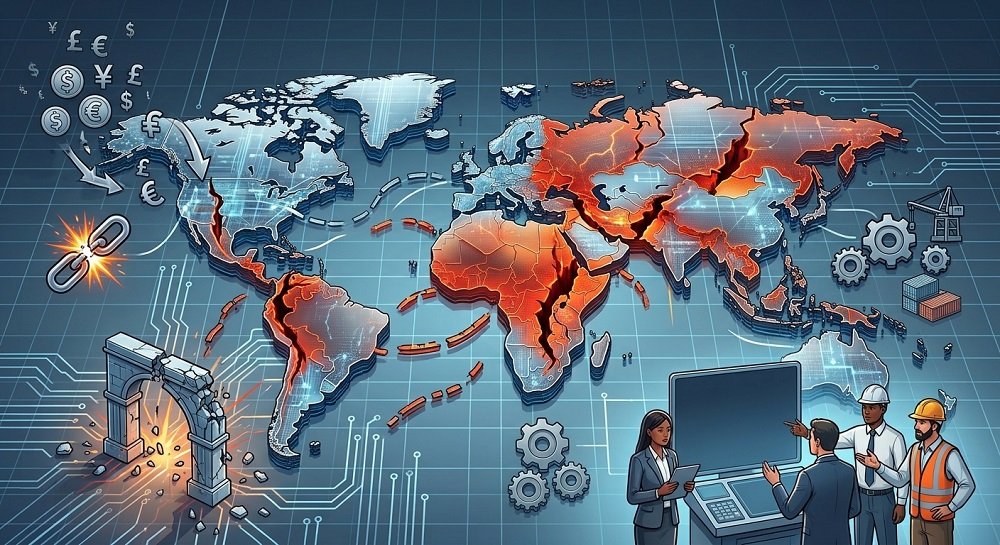
As fiscal support loses force globally, Nigeria faces a more demanding test: turning macroeconomic stabilisation into investment, productivity and higher purchasing power
Nigeria is entering a changing global economic environment at a significant point in its own reform programme.
The World Economic Forum’s September 2026 Chief Economists’ Outlook says the global economy is stabilising, but governments have less fiscal room to absorb another major shock. That shift matters for Nigeria, where the authorities are still working to translate recent macroeconomic reforms into stronger investment, lower inflation and broader improvements in living standards.
The WEF survey finds that 69 percent of chief economists regard fiscal support as the most significant source of global resilience since 2020. Only 28 percent expect it to play the same role over the next year. Instead, economists expect resilience to depend increasingly on flexible supply chains, technological innovation and adaptation in energy markets.
For Nigeria, that puts greater emphasis on the strength of the underlying economy rather than the availability of another large fiscal cushion.
Nigeria’s recovery still faces an inflation problem
Nigeria’s macroeconomic position has improved in important respects, according to the International Monetary Fund, but inflation and external shocks remain significant risks.
In its June 2026 Article IV assessment, the IMF estimated real GDP growth at 4.0 percent in 2025 and projected growth of 4.1 percent in 2026. It said recent reforms — including the end of fuel subsidies and deficit monetisation, tighter monetary policy and exchange-rate liberalisation — had strengthened macroeconomic stability, rebuilt external buffers and improved foreign-exchange market functioning.
But the Fund also projected inflation to rise to 17 percent year-on-year by the end of 2026, after inflation had increased from 15.1 percent year-on-year in February to 15.4 percent in March as global fuel and food-price pressures intensified.
That creates a problem familiar from the WEF’s global findings: GDP can continue to expand while households remain under pressure.
The WEF expects food, electricity and transport costs to rise globally, with 88 percent of chief economists anticipating higher food prices, 83 percent higher electricity costs and 77 percent higher transport costs.
For Nigeria, where food and transport have substantial effects on household budgets and business costs, those global pressures can feed directly into domestic inflation and purchasing power.
The fiscal question is changing
The global reduction in fiscal space also matters for Nigeria’s development model.
The IMF says Nigeria’s reforms have reduced fiscal vulnerabilities, but the country’s public finances still face substantial demands from debt service, infrastructure and social spending. The Fund’s projections put public-sector gross debt at elevated levels and emphasise the need for continued fiscal consolidation alongside measures to strengthen revenue mobilisation and protect priority spending.
The implication of the WEF’s findings is not that Nigeria should simply spend less.
It is that public resources may need to be used increasingly to strengthen the conditions under which private investment and productivity can expand.
That makes reliable electricity, transport infrastructure, digital connectivity, predictable regulation, access to finance and efficient trade logistics economic policy issues as much as infrastructure issues.
Fragmentation could create an opening
The reorganisation of global trade may offer Nigeria an opportunity.
The WEF expects geoeconomic fragmentation to increase, with 77 percent of chief economists anticipating greater fragmentation over the next year. Yet two-thirds still expect global trade volumes to increase, while 83 percent expect Chinese exports to markets outside the United States to rise.
The message is that globalisation is changing rather than disappearing.
That could create opportunities for economies able to attract investment and integrate into new supply chains.
Nigeria has a large domestic market and sits within Africa’s largest regional economic market. But those advantages do not automatically translate into internationally competitive production.
The World Bank’s June 2026 outlook says reforms in Nigeria, including exchange-rate liberalisation, improvements in public financial management and other business-friendly measures, are among the factors supporting the country’s economic outlook. At the same time, it says structural constraints continue to limit growth.
The competition is therefore not simply for foreign capital.
It is for the production, exports and jobs that capital can create.
AI: beyond the data-centre race
Artificial intelligence offers another opportunity, but the WEF findings suggest that Nigeria should distinguish between attracting AI infrastructure and capturing AI-driven productivity gains.
Ninety-seven percent of surveyed chief economists expect AI adoption to increase over the next year, while 69 percent expect meaningful productivity gains. But 61 percent do not expect data-centre investment to account for a significant share of global job creation.
That distinction is particularly relevant for an economy with a large and growing labour force.
Data centres can bring investment and digital infrastructure, but their direct employment effects are limited relative to the scale of Nigeria’s labour-market challenge.
The larger opportunity is the application of AI and digital infrastructure across existing industries — including financial services, agriculture, logistics, manufacturing and professional services — while developing digitally delivered exports.
That requires more than technology. It requires reliable electricity, broadband infrastructure, skills, access to computing capacity and domestic firms capable of adopting the technology.
The cost-of-living transmission
Nigeria is also exposed to the transmission mechanism behind the WEF’s global cost-of-living concerns.
Transport costs affect the movement of food and industrial inputs. Energy costs affect production, logistics and services. Food prices affect household purchasing power and therefore consumer demand.
The IMF has already identified rising international transport costs and higher global food and fuel prices as risks to Nigeria’s non-oil activity and inflation outlook.
This makes the quality of Nigeria’s stabilisation particularly important.
A reduction in headline inflation would matter, but the broader test is whether lower inflation is eventually accompanied by stronger real incomes, more predictable operating costs and greater investment.
From stabilisation to productivity
The September WEF Outlook places Nigeria’s domestic economic reforms within a wider global transition.
The immediate challenge of stabilisation is being followed by a more difficult one: building an economy capable of absorbing shocks without relying excessively on extraordinary government intervention.
For Nigeria, that means continuing efforts to strengthen public finances while protecting productive investment; improving infrastructure and energy reliability; reducing barriers to trade; deepening domestic and regional markets; and creating conditions for long-term private capital.
The global environment is also becoming more competitive.
As companies reassess supply chains and governments seek new sources of investment, countries with reliable infrastructure, predictable policies, competitive production costs and access to markets will be better positioned to participate in the reorganisation of global trade.
Nigeria cannot control the geopolitical forces driving that reorganisation.
It can influence the domestic conditions that determine whether those forces create opportunities for Nigerian firms and workers.
The WEF’s latest outlook therefore poses a broader question for Nigeria than whether growth will continue.
Can the country turn its current period of macroeconomic stabilisation into the productive capacity, investment and household purchasing power needed to withstand the next global shock?