
Business A.M
No Result
View All Result
Saturday, October 17, 2026
  • Login
  • Technology
  • Finance
  • Comments
  • Companies
  • Commodities
  • ONLINE & DIGITAL CONTENT PACKAGE
Subscribe
Business A.M
  • Technology
  • Finance
  • Comments
  • Companies
  • Commodities
  • ONLINE & DIGITAL CONTENT PACKAGE
No Result
View All Result
Business A.M
No Result
View All Result
Home Interview

‘Losing monetary independence is not worth it if trade is less than 10%’

by Admin
May 28, 2018
in Interview

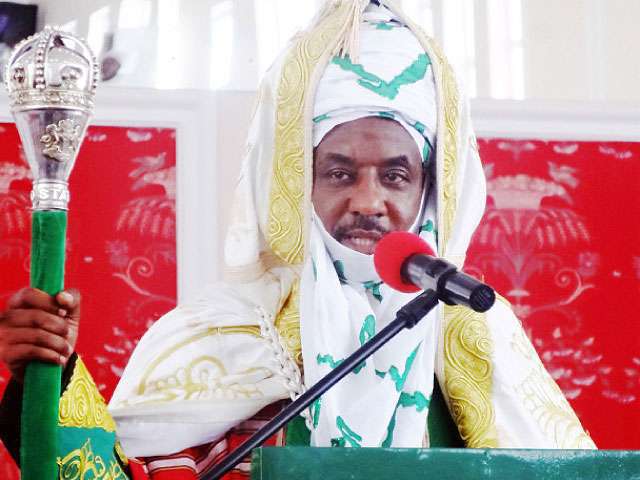
Muhammadu Sanusi II, the Emir of Kano and a former Governor of Nigeria’s Central Bank, fielded questions bordering on the state of industrialization, integration, investments, and finance on the African continent at sideline of the 2018 Annual Meetings of the African Development Bank Group in Busan, Korea. Business a.m.’s ADESOLA AFOLABI who monitored the televised interview brings the excerpts:

Recently, Africa has revamped various efforts towards ensuring continental regional integration such as the CFTA. The ECOWAS is also meeting possibilities of a single currency while the African Union is planning to build high street railways to connect all the continent’s major cities. When you look at all of this, how can these impact industrialization going forward?

I think some of them are extremely good measures, but some of them need to be slowed down a bit. I think a trade document is important, while the railways and infrastructures are critical. Before you actually begin to move forward on a single currency, you need to improve traffic and trade.
The transaction costs that you save do not justify a single currency, and losing monetary independence if the trade is less than 10 percent is not worth the while. So we need to get trade to a level; these Asians countries that have 35 percent trade among themselves don’t even have a single currency though they do peg themselves to the euro in one way or another.

I think that before you move to a single currency in West Africa or in Africa, you need to build trade relations so that it makes sense, and you can save transaction cost behind the single currency we are moving to. The infrastructure, the trade agreements, the coordinated economic approach to the world is important. Look, Europe negotiates to China as a bloc, if Europe can trade as a bloc, why can’t we in Africa trade as a bloc.

What are the roles of our fiscal and monetary authorities in Africa towards creating efficient markets?

First of all, the finance ministers and the central banks should focus on providing a stable macroeconomic environment. The central bank is to provide macro stability along with finance. Some of the things the finance ministries can do are to look critically at increasing the tax base, improving allocative efficiency, and improving public financial management.

That is the work of a finance minister, and as finance ministers continue to improve that and people begin to see more transparency in their dealings, and how government revenue is being spent, then there would be progress. Equally, the different government agencies should have greater transparency in management and investment.

For example, if the finance ministry allocates money to an individual ministry, that ministry has the responsibility for making sure that it does what it’s supposed to do. So, the government as a whole needs to do this. When you look at countries like Rwanda, Cote D’Ivoire, Senegal, Kenya, etc., this is what they are now focusing on, and this is why their reputations are improving and investors keep coming. We need foreign investors, but there are enough local domestic savings to finance a significant part of industrialization if we have the system in place.

You talked about Africa coming together to trade as a bloc with China and the rest of the world during your presentation; can you please elaborate on that?

Well, you need to have a more level playing field when you are negotiating. Imagine China negotiating with the Benin Republic or with Cameroun, but when you have something like the China-Africa forum, African countries interest will actually have been unified. So before we go to such forums, wherever they have it, let us as Africans identify what we want from China, what are our demands? And right now what we want from China is to want China to see how these labor-intensive industries can come to Africa and not to Bangladesh, Pakistan or Malaysia. How do you negotiate that? What environment do you create for that? This will create at least 100 million jobs to the African continent. How do you work on the trade deficit in China? By getting China to buy more African goods. If China moves away from an investment-driven mode to a consumption-driven model, how do you produce those goods that China needs to consume so that we now produce these goods on the African continent and export to them and earn foreign exchange. That way you get the investments, you’ve improved your terms of trade and you stimulate economic growth. But you can only do that if you have a coordinated approach to China.

What do migration and shared prosperity mean for industrialization in Africa?

People migrate from Africa because they are moving away from the ghettos that have been created by an unequal world, and if Europe sees migration as a problem, it needs to focus on poverty as a problem as well.

What would it cost to invest in converting all the solar energy that we have in the Sahel, into electricity so that industries can be created and jobs can be created for these young men so that they don’t need to travel to Europe.

Why can’t we look positively at how we can bring back, some of that prosperity back to Africa, rather than continue to take away and profit from investment in Africa while blocking Africans from continuing to share in that prosperity. Why should Africans be part of this conversation where we are encouraging breaking down all the barriers to the movement of capital, to movement of profits, movement of dividends, while we are putting barriers around human beings. These are the kinds of questions that as Africans we need to start asking, to get out of this post-colonial, neo-colonial mindset and move into a world in which we are thinking as Africans and where African interest is our interest.


Admin
Admin
Previous Post

A little inflation will not hurt Nigeria’s economy, investment analyst says

Next Post

Kemi Adeosun: Driving far-reaching reforms in Nigeria’s fiscal operations management

Next Post

Kemi Adeosun: Driving far-reaching reforms in Nigeria’s fiscal operations management

  • Trending
  • Comments
  • Latest

How UNESCO got it wrong in Africa

May 30, 2017

CBN to issue N1.5bn loan for youth led agric expansion in Plateau

July 29, 2025
MMA2 enters new commercial era after 20-year concession dispute

MMA2 enters new commercial era after 20-year concession dispute

August 28, 2026
NGX taps tech advancements to drive N4.63tr capital growth in H1

Insurance-fuelled rally pushes NGX to record high

August 8, 2025

6 MLB teams that could use upgrades at the trade deadline

Top NFL Draft picks react to their Madden NFL 16 ratings

Paul Pierce said there was ‘no way’ he could play for Lakers

Arian Foster agrees to buy books for a fan after he asked on Twitter

Rivers, China's CNCECC sign deal for $3.5bn methanol, fertiliser plant

Rivers, China’s CNCECC sign deal for $3.5bn methanol, fertiliser plant

October 17, 2026
Methane rules spread across 67% of global production as Nigeria faces compliance test 

Methane rules spread across 67% of global production as Nigeria faces compliance test 

October 17, 2026
Onafriq, a pan-African payments company, is set to discontinue its Baxi agent banking business in Nigeria after five years, citing naira depreciation, rising operating costs and intensifying competition that have weakened the segment’s profitability. The planned shutdown will affect the agent banking operations conducted through Baxi under Onafriq Nigeria Payments Limited. However, the decision does not signal the company’s withdrawal from Nigeria, as it intends to retain its cross-border payments network and card issuing services in the country. In a statement, Onafriq said changes in Nigeria’s operating environment since 2024 had significantly altered the economics of its offline agent banking business, making the existing model unsustainable. The move marks a strategic shift for the company, which entered Nigeria’s agent banking market to expand access to financial services through a network of agents providing transaction services outside traditional bank branches. Onafriq attributed the decision to a combination of macroeconomic pressures and structural changes in the country’s payments industry. According to the company, naira depreciation and inflation have affected transaction volumes, increased operating expenses and undermined the sustainability of its agent banking operations. The growing adoption of instant account-to-account transfers has also changed the mix of transactions handled by agents, while heightened competition among payment service providers has put further pressure on margins. These developments have made it increasingly difficult for the business to remain viable under its existing operating structure, prompting the company to reassess its long-term strategy. Dare Okoudjou, founder and chief executive officer of Onafriq, said the decision to close the business was difficult, particularly given the efforts of employees, agents and business partners who helped build the Baxi network. “We entered Nigeria with conviction and commitment, but did not achieve the outcome we set out for. Closing this business was a difficult decision to arrive at, one that affects colleagues, agents, and business partners across Nigeria who poured their hearts and soul into building out the Baxi network,” Okoudjou said. Despite the closure, he reaffirmed the company’s commitment to the Nigerian market, noting that the group would continue to serve customers through its payments network and card issuing operations. Onafriq entered Nigeria’s agent banking market in 2021 through the acquisition of Baxi, also known as Capricorn Digital Limited. The company said it continued investing in the business through 2023, with efforts focused on expanding and strengthening its agent network. However, a subsequent review of the business’s long-term prospects and financial sustainability led to the decision to wind down the operation. As part of the transition, Onafriq said agents onboarded through the Baxi platform had been moved to another principal bank, a step intended to facilitate continuity for the affected agents. The company has also directed agents to transfer their funds to their preferred principal bank within 30 days, adding that its teams would provide support throughout the transition process. Employees whose roles are linked to the agent banking business will also be consulted and supported during the wind-down, with Onafriq pledging to treat affected workers fairly.

Onafriq winds down Baxi as Nigeria’s agent banking economics worsen

October 17, 2026
LCFE links petroleum trading to capital market in pricing transparency drive

LCFE links petroleum trading to capital market in pricing transparency drive

October 17, 2026

Popular News

  • How UNESCO got it wrong in Africa

    0 shares
    Share 0 Tweet 0
  • CBN to issue N1.5bn loan for youth led agric expansion in Plateau

    0 shares
    Share 0 Tweet 0
  • MMA2 enters new commercial era after 20-year concession dispute

    0 shares
    Share 0 Tweet 0
  • Insurance-fuelled rally pushes NGX to record high

    0 shares
    Share 0 Tweet 0
  • Glo, Dangote, Airtel, 7 others prequalified to bid for 9Mobile acquisition

    0 shares
    Share 0 Tweet 0
Currently Playing

CNN on Nigeria Aviation

CNN on Nigeria Aviation

Business AM TV

Edeme Kelikume Interview With Business AM TV

Business AM TV

Business A M 2021 Mutual Funds Outlook And Award Promo Video

Business AM TV

Recent News

Rivers, China's CNCECC sign deal for $3.5bn methanol, fertiliser plant

Rivers, China’s CNCECC sign deal for $3.5bn methanol, fertiliser plant

October 17, 2026
Methane rules spread across 67% of global production as Nigeria faces compliance test 

Methane rules spread across 67% of global production as Nigeria faces compliance test 

October 17, 2026

Categories

  • Frontpage
  • Analyst Insight
  • Business AM TV
  • Comments
  • Commodities
  • Finance
  • Markets
  • Technology
  • The Business Traveller & Hospitality
  • World Business & Economy

Site Navigation

  • Home
  • About Us
  • Contact Us
  • Privacy & Policy
Business A.M

BusinessAMLive (businessamlive.com) is a leading online business news and information platform focused on providing timely, insightful and comprehensive coverage of economic, financial, and business developments in Nigeria, Africa and around the world.

© 2026 Business A.M

Welcome Back!

Login to your account below

Forgotten Password?

Retrieve your password

Please enter your username or email address to reset your password.

Log In
No Result
View All Result
  • Technology
  • Finance
  • Comments
  • Companies
  • Commodities
  • ONLINE & DIGITAL CONTENT PACKAGE

© 2026 Business A.M




