-
Spends $2.1bn on defence against $33bn by top 5
-
Global defence spending hits $2.89trn in 2025
-
Africa’s military expenditure up 8.6% to $58.2bn
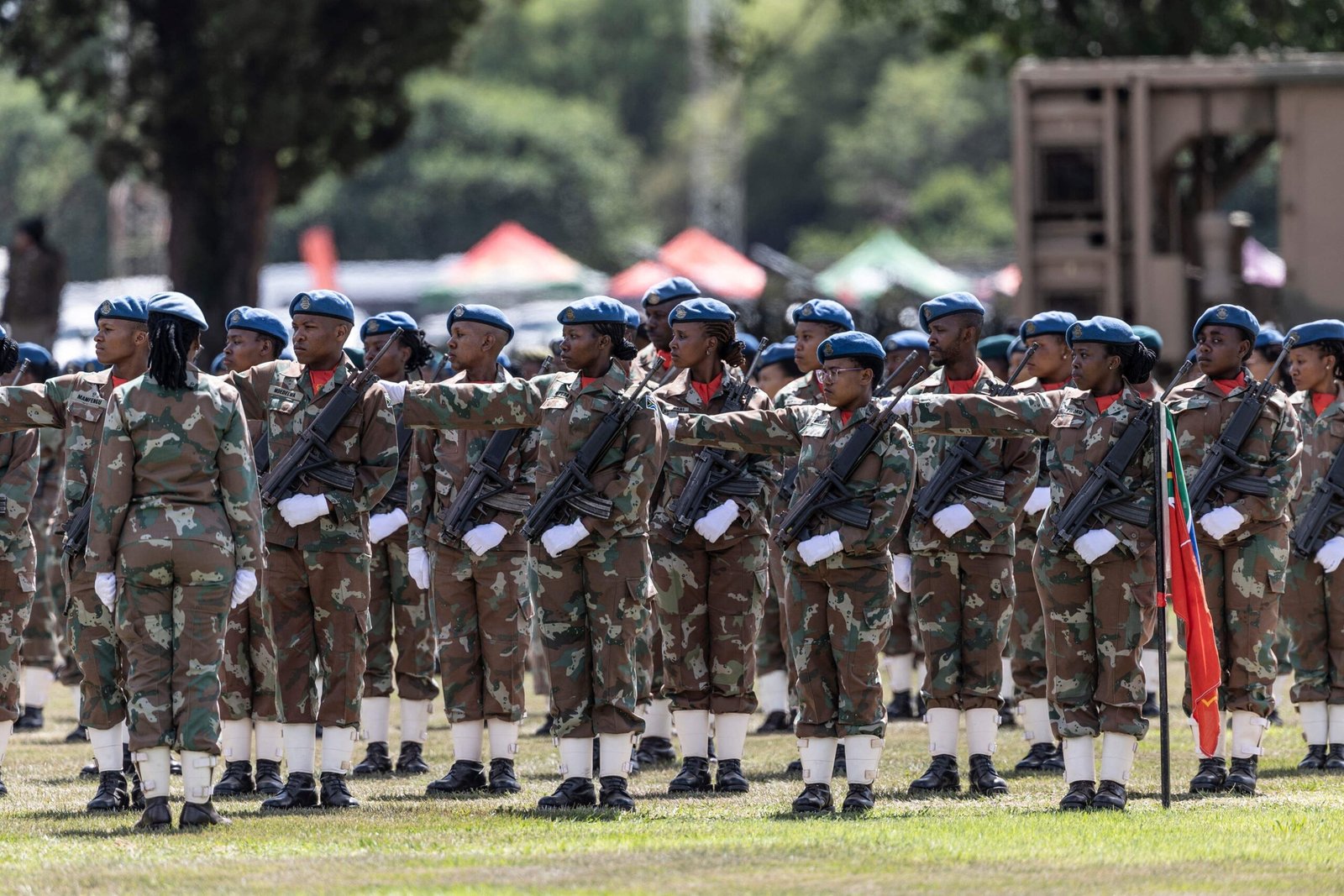
Nigeria, despite budgeting $2.1 billion on defence (or N3.10 trillion) in 2025, amid mounting insecurity, is not among Africa’s five most militarised economies, which combined spent $33 billion on defence last year, according to a new report by the Stockholm International Peace Research Institute (SIPRI).
Despite using heavy military action against terrorists, insurgents, and bandits since the last decade, the country’s defence spending has yet to inch to the top defence burdens on the continent.
The ranking, the report said, is based on military spending as a share of the gross domestic product (GDP).
According to SIPRI, Africa’s five most militarised economies spent more than $33 billion on defence last year, which is indicative of how a small group of countries have continued to dominate the continent’s military spending following continued security pressures.
In addition, these countries’ military spending is chiefly driven by continued security pressures, rather than by economic growth.
Algeria tops the list with a military expenditure of $25 billion, which was 8.8 percent of its GDP for last year. The North African country is second only to Ukraine globally, principally due to its regional tensions with Morocco.
According to SIPRI, Algeria’s military burden of 8.8 percent of GDP in 2025 makes it the world’s second most militarised economy after Ukraine. Its $25.4 billion defence budget reflects both sustained military investment and long-standing regional tensions, mainly with Morocco over Western Sahara.
Mali, a member of the volatile Alliance of Sahel States (AES), follows with $0.9 billion defence expenditure which was 3.9 percent of its GDP in 2025.
Morocco, with $6.3 billion or 3.5 percent of its GDP as defence budget last year is the third most militarised economy. South Sudan, the newly carved country from Islamic Republic of Sudan, is the fourth militarised economy in Africa, spending $0.2 billion (or 3.4 percent of GDP) on defence in 2025.
Burkina Faso is in the 5th place, which along with Mali, focus on high defence budgets to counter jihadist insurgencies. For Morocco and Algeria, they emphasize geopolitical rivalry.
On the global scale, SIPRI said, military expenditure grossed a record $2.89 trillion in 2025, marking the 11th consecutive year of growth.
The military burden, a key measure of how heavily defence spending weighs on an economy, captures the share of national output directed toward the military. It provides a clearer picture of economic prioritisation than absolute spending alone.
Meanwhile Africa’s military spending hit new highs for the third time despite the continent’s ongoing security problems, especially in the Sahel region. Africa’s total military expenditure reached $58.2 billion in 2025, marking an 8.5 percent increase year-on-year. Data from the SIPRI military expenditure database said, this growth represents the third consecutive year of increases and a 45 percent expansion since 2016. SIPRI said this reflects a sustained upward trend in defence budgets across the continent.
SIPRI, founded in 1966 in Sweden, is an independent international institute dedicated to researching conflict, armaments, arms control, and disarmament. It provides authoritative data and analysis to policymakers, researchers, and the media to promote global transparency and peace, maintaining extensive publicly accessible databases detailing global military expenditures and the international arms trade.
Despite this sustained military budget increase, Africa’s average military burden stood at 1.8 percent of GDP, concealing sharp inequalities between relatively stable economies and those facing protracted insecurity or regional tensions.
It is indicative that the continent’s top five militarised economies alone accounted for more than half of the continent’s total military expenditure, emphasising how concentrated defence expenditure remains.
ALSO : Dangote’s ambition uplifts Nigeria’s position in global refined fuel league
Opposing systems, common economy
Indeed, the top five militarised countries share an essential characteristic: security necessity is driving defence spending, rather than economic expansion. They operate opposition political systems but common economy ― military spending. Across the five countries, security concerns remain a determined structural issue, shaping economic performance and investor confidence far beyond the short term. Consequently, defence spending continues to contend directly with development concerns such as infrastructure, education and healthcare, restraining fiscal space for broader economic transformation.
For instance, in the Sahel, Mali and Burkina Faso, classified among the world’s poorest countries, with extremely low human development index (HDI), the two countries are battling deep-rooted jihadist insurgencies that have expanded across borders, forcing governments to prioritise counterterrorism operations over long-term development spending. These conflicts have also sapped state capacity, forcing growing reliance on military institutions for internal stability.
In North Africa, though Morocco and Algeria represent two contrasting economic models where the former (Morocco) operates a diversified, open-market economy driven by services, manufacturing, and renewable energy, and the latter (Algeria) runs a state-dominated ‘rentier’ economy heavily reliant on oil ad gas exports for government revenues, both nations reflect an entrenched long-standing geopolitical rivalry and territorial disputes, shaping their defence policy. Military spending in both countries remains closely tied to deterrence and regional balance of power considerations.
To wit, the two North African powers combined spend at least $31.3 billion and 12.3 percent of GDP in an intensifying arms race backed by the US and Russia
South Sudan, a fragile state, which gained independence only in July 2011, represents militarisation driven by fragile polity. Repeated internal conflict, political instability and weak institutions continue to mount sustained pressure on government resources, keeping defence spending unduly high relative to economic output.