Business A.M
No Result
View All Result
Monday, February 16, 2026
  • Login
  • Home
  • Technology
  • Finance
  • Comments
  • Companies
  • Commodities
  • About Us
  • Contact Us
Subscribe
Business A.M
  • Home
  • Technology
  • Finance
  • Comments
  • Companies
  • Commodities
  • About Us
  • Contact Us
No Result
View All Result
Business A.M
No Result
View All Result
Home Frontpage

United States rate hike may put Nigeria, others under pressure

by Admin
June 15, 2017
in Frontpage
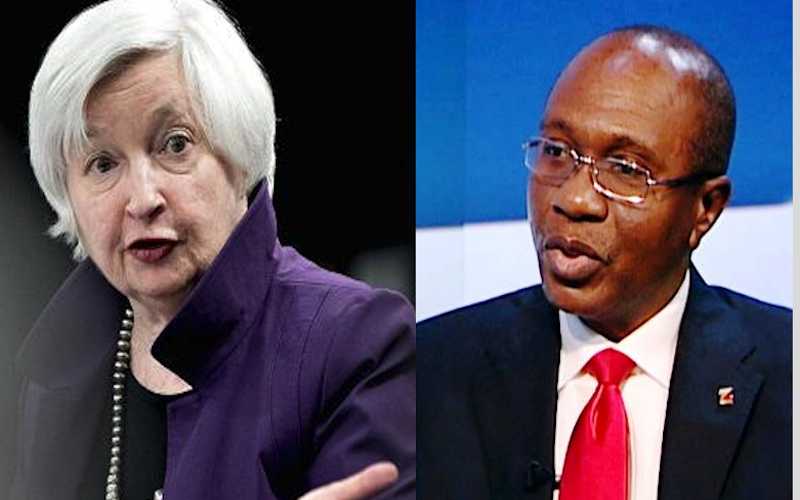
Janet Yellen, chair of the U.S. Federal Reserve, Godwin Emefiele, Central Bank of Nigeria governor

The U.S. Federal Reserves decision to hike rates from 1.0 percent to 1.25 percent as announced by its chair, Janet Yellen, on Wednesday could put emerging economies, including Nigeria, under pressure, as the decision would redirect investment flows to the U.S. at their expense.

The Fed’s rates hike is expected to redirect investments to the U.S, which has kept rates low as it tries to reflate its economy.

Yellen justified the hike by highlighting the resilience of the U.S. economy, which has been buoyed by a robust labour market. While also indicated that a third rate hike is not unlikely in 2017. An eventual increase to the 2.0 percent target could occur in the medium term, analysts predict.

She had told the U.S. Congress on 14, February 2017 that waiting too long to raise interest rates would be “unwise” as economic growth continues and inflation rises.

Already, global stock markets responded negatively to the decision as capital markets in Asia, Africa and Europe responded in unison as they opened Thursday in the red.

While Tokyo’s Topix slipped 0.2 per cent, Hong Kong’s Hang Seng index was down across the board in the early hours of trading on June 15. Though the Nigerian Capital market managed to sustain its comeback, the Johannesburg All Share Index dropped 1.15 percent as at local 12.33pm local time.

“Many African countries including Nigeria failed to take full advantage of the low rates in the U.S. while it persisted. They could have done better by investing more in infrastructure and reducing the level of macroeconomic risk so as to take full advantage of the decline in lending rates in the U.S.,” Bongo Adi, a don at the Pan Atlantic University told Businessamlive in a telephone conversation.

“With the US economy post better growth indicators and considering that it is lower on risks, which are common in emerging nation, it will take the shine off most emerging nations bonds.”

For Nigeria, this comes at a time when rating agency Fitch assigned a  ‘B+(EXP) rating to its upcoming U.S. dollar denominated senior unsecured Diaspora Bonds. The rating agency put into consideration Nigeria’s Long-Term Foreign-Currency Issuer Default Rating (IDR) of ‘B+’, which has a negative outlook, in arriving at the rating for the bonds.

“One of the implications of the rates spikes in the U.S. is that the cost of borrowing at the international debt market could increase dramatically as the U.S. continues to increase its base-lending rate,” Adi said.

“To meet our borrowing targets going forward, we need to be ready to pay more.”

Furthermore, rate spikes in the U.S. could also put pressure on the sovereign rating of developing countries, many of which took advantage of low U.S. interest rates to borrow in U.S. dollars.

When the Fed last hiked rates at its December 2016 meeting, Federal Open Market Committee members indicated three more increases were likely in 2017, though many market watchers realistically now expect just two moves.

In the wake of the 2008 global financial crisis emerging markets have seen significant foreign direct investment with bonds in the U.S. and European recording lower yields, investors flocked into higher yielding emerging market stocks and bonds to bolster their portfolios yields.

“If the dollar rises in value, as is the case when there are hikes, commodity prices and emerging nation currencies could come under further downward pressure. Which is bad news because most commodities are sold in U.S. dollars, which means that they will generate less revenue in real terms,” says Adi.

With commodity prices under pressure already, emerging markets that rely on commodities may have a heavier debt burden than previously anticipated.


Admin
Admin
Previous Post

Inflationary trend not positive yet as food prices rise 19% in May

Next Post

South Africa’s resources stocks weaken after release of mining charter

Next Post

South Africa's resources stocks weaken after release of mining charter

  • Trending
  • Comments
  • Latest
Igbobi alumni raise over N1bn in one week as private capital fills education gap

Igbobi alumni raise over N1bn in one week as private capital fills education gap

February 11, 2026
SIFAX subsidiary bets on operational discipline, cargo diversification to drive recovery at Lagos terminal

SIFAX subsidiary bets on operational discipline, cargo diversification to drive recovery at Lagos terminal

February 10, 2026

Reps summon Ameachi, others over railway contracts, $500m China loan

July 29, 2025
NGX taps tech advancements to drive N4.63tr capital growth in H1

Insurance-fuelled rally pushes NGX to record high

August 8, 2025

6 MLB teams that could use upgrades at the trade deadline

Top NFL Draft picks react to their Madden NFL 16 ratings

Paul Pierce said there was ‘no way’ he could play for Lakers

Arian Foster agrees to buy books for a fan after he asked on Twitter

AfriGO cards launch on PalmPay app as Nigeria pushes domestic payments adoption

AfriGO cards launch on PalmPay app as Nigeria pushes domestic payments adoption

February 15, 2026
Credit constraints, price volatility cloud agribusiness outlook

Credit constraints, price volatility cloud agribusiness outlook

February 15, 2026
Bedrock Residences appoints Kofo Ati-John as chairman

Bedrock Residences appoints Kofo Ati-John as chairman

February 14, 2026
Nigerian Breweries rated ‘buy’ as analysts see stronger earnings demand driving recovery

Nigerian Breweries returns to profitability with N99bn net income

February 14, 2026

Popular News

  • Igbobi alumni raise over N1bn in one week as private capital fills education gap

    Igbobi alumni raise over N1bn in one week as private capital fills education gap

    0 shares
    Share 0 Tweet 0
  • SIFAX subsidiary bets on operational discipline, cargo diversification to drive recovery at Lagos terminal

    0 shares
    Share 0 Tweet 0
  • Reps summon Ameachi, others over railway contracts, $500m China loan

    0 shares
    Share 0 Tweet 0
  • Insurance-fuelled rally pushes NGX to record high

    0 shares
    Share 0 Tweet 0
  • What’s Behind the Fourth-Quarter Earnings Dip?

    0 shares
    Share 0 Tweet 0
Currently Playing

CNN on Nigeria Aviation

CNN on Nigeria Aviation

Business AM TV

Edeme Kelikume Interview With Business AM TV

Business AM TV

Business A M 2021 Mutual Funds Outlook And Award Promo Video

Business AM TV

Recent News

AfriGO cards launch on PalmPay app as Nigeria pushes domestic payments adoption

AfriGO cards launch on PalmPay app as Nigeria pushes domestic payments adoption

February 15, 2026
Credit constraints, price volatility cloud agribusiness outlook

Credit constraints, price volatility cloud agribusiness outlook

February 15, 2026

Categories

  • Frontpage
  • Analyst Insight
  • Business AM TV
  • Comments
  • Commodities
  • Finance
  • Markets
  • Technology
  • The Business Traveller & Hospitality
  • World Business & Economy

Site Navigation

  • Home
  • About Us
  • Contact Us
  • Privacy & Policy
Business A.M

BusinessAMLive (businessamlive.com) is a leading online business news and information platform focused on providing timely, insightful and comprehensive coverage of economic, financial, and business developments in Nigeria, Africa and around the world.

© 2026 Business A.M

Welcome Back!

Login to your account below

Forgotten Password?

Retrieve your password

Please enter your username or email address to reset your password.

Log In
No Result
View All Result
  • Home
  • Technology
  • Finance
  • Comments
  • Companies
  • Commodities
  • About Us
  • Contact Us

© 2026 Business A.M