Nigeria is turning to global sustainability reporting standards to help unlock billions of dollars in investment needed to close a $31.5 billion annual development funding gap, as ESG disclosures become a key requirement for attracting long-term capital.
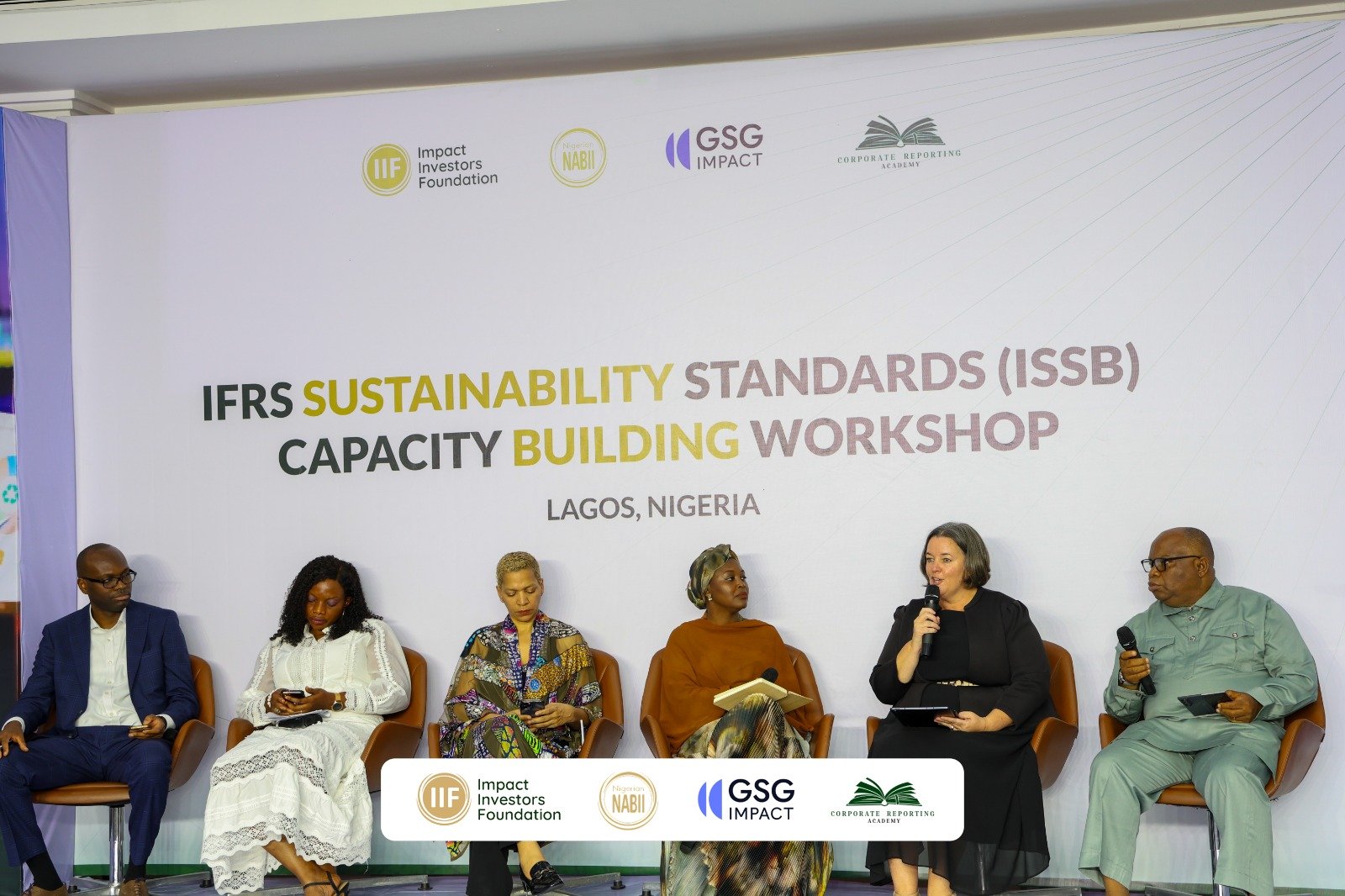
This agenda gained fresh momentum at a three-day IFRS Sustainability Reporting capacity-building workshop in Lagos, convened by the Impact Investors Foundation (IIF) and the Corporate Reporting Academy (CRA). The event brought together regulators, corporates, and development actors to accelerate Nigeria’s readiness for the adoption of the International Sustainability Standards Board (ISSB) framework.
For Nigeria, the shift toward ISSB adoption represents more than a compliance exercise; it signals a structural repositioning of the country within global capital markets. As investors increasingly demand transparency around sustainability risks and opportunities, countries that fail to meet disclosure expectations risk being sidelined in capital allocation decisions.
Speaking at the workshop, Etemore Glover, chief executive officer of the Impact Investors Foundation, framed the issue in stark terms, linking sustainability reporting directly to capital access and economic competitiveness.
“These standards are rapidly becoming indispensable for global markets. As sustainability-related financial disclosures gain prominence, investors and regulators increasingly rely on them to assess corporate resilience, market risk, and attract international capital,” Glover said.
She added that standardisation of sustainability disclosures is critical to bridging financing gaps in emerging markets.
“By standardising how we communicate environmental and social impacts, we take meaningful steps towards closing the $1 trillion annual financing gap required for developing countries to achieve the Sustainable Development Goals. In Nigeria, it’s valued at about $31.5 billion, and that is whopping,” she noted.
Industry experts say the emphasis on sustainability reporting reflects a broader shift in global finance, where ESG considerations are increasingly integrated into investment decision-making. For Nigeria, aligning with ISSB standards could enhance investor confidence, improve risk pricing, and deepen participation in international capital markets.
Iheanyi Anyahara, the chief executive of the Corporate Reporting Academy, stressed that the country must now move beyond awareness to execution. According to him, the focus is shifting toward equipping institutions with the technical capabilities required to implement sustainability reporting frameworks effectively.
“Nigeria is not merely participating in global sustainability conversations; we are actively helping to shape it,” Anyahara said, pointing to ongoing consultations and the establishment of a dedicated working group to support implementation.
He added that building local capacity will be critical to ensuring that Nigerian companies can meet disclosure requirements without compromising operational efficiency.
The transition also reflects an evolving narrative around sustainability within the Nigerian business environment. According to Adewale Ajayi, a member of the Board of Trustees at the Impact Investors Foundation, the debate has moved from questioning relevance to addressing execution.
“It’s very important for us to note that when we talk about sustainability, especially in this country now, we’re at a critical junction on a sustainability journey. Some years back, we used to wonder about sustainability; we used to talk about why it may be important and relevant to us. But the talk is no longer about relevance. We’re talking about how we measure, how we discuss, and how we report,” Ajayi said.
Ajayi emphasised that the adoption of IFRS S1 and S2 standards would strengthen corporate transparency by requiring companies to disclose sustainability-related risks, opportunities, and climate-related data in a structured and comparable manner.
Regulators are also signalling support for the transition, albeit with a pragmatic approach to implementation. Emomotimi Agama, the director-general of the Securities and Exchange Commission (SEC) Nigeria, reiterated the government’s commitment to adopting global standards while acknowledging the technical complexities involved.
Speaking through Tony Iloka, the Commission’s Divisional Head of Legal (REMI), Agama said the adoption process would be phased and tailored to local realities.
“We are not in the business of mandating standards that our market cannot wisely implement. Proportionality, phasing, and capacity support are essential features of any credible implementation roadmap, and they are features that the Commission intends to bring explicitly into its revised sustainability reporting framework,” he said.
Agama also pushed back against concerns about Nigeria’s readiness, citing the country’s track record in adopting complex global standards, including IFRS and international auditing frameworks.
“The Nigerian corporate sector has demonstrated repeatedly its capacity to absorb and implement complex regulatory reporting frameworks. What is required is not a lowering of standards, but a structured, well-supported, adequately resourced implementation programme,” he added.
Market analysts note that the success of Nigeria’s sustainability reporting transition will depend on several factors, including data infrastructure, institutional capacity, and regulatory coordination. However, they argue that the potential upside is significant.
By aligning with ISSB standards, Nigerian companies could gain improved access to global capital pools, particularly from institutional investors that prioritise ESG compliance. This, in turn, could lower the cost of capital, support long-term investment, and drive sustainable economic growth.
Other experts who spoke during the event included Femi Shobanjo, the chief executive officer, NGX Limited; Rukaiya El-Rufai, chief executive, SALI Technology, UK; Eberechi Weli, special adviser to the president on NEC & Climate Change; Onyinyechi Eneh, head of department, Nnamdi Azikiwe, University Awka, Anambra State; Ndidi Nnoli, director, ISSB; among others.